




Global week in review: soft news is good news
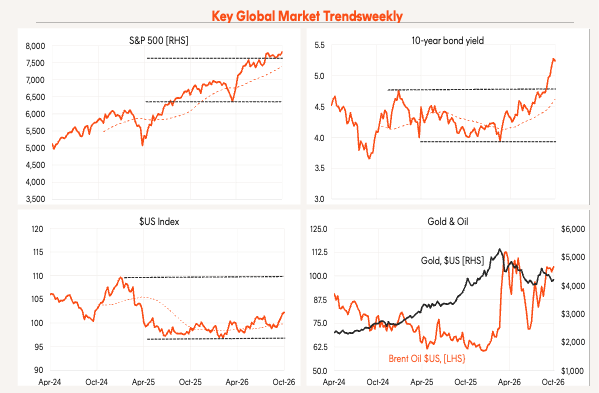
US equities firmed last week with a soft US payrolls report easing fears of another near-term US rate hike. Optimism around AI and the latest US earnings season also bolstered sentiment.

Source: Betashares, Bloomberg.
Key global news last week included a relatively hawkish set of minutes from the recent Fed meeting and mixed reports on the flow of oil through the Middle East.
As regards the Fed, the minutes confirmed what the “dot plot” of Fed members’ fund rate forecasts suggested, namely “most” saw the need for likely further policy tightening.
That said, the minutes pre-dated the previous Friday’s soft payrolls report and, while the market still expects several more rate hikes in coming months, it attaches only a 20% chance to a rate hike at the next meeting late this month. My base case is the Fed will likely raise rates once more by year-end – though not likely this month – and won’t follow through with the market’s expectation of further rate hikes next year.
Of course, it would help if the stand-off in the Middle East could be resolved sometime soon. Alas, tensions remain. While there’s been a welcome rebound in oil supply through the Middle East using non-traditional means, Iran last week stepped up its attacks on shipping and oil prices remain uncomfortably high at around $US102/barrel.
Solid corporate earnings are allowing equities to continue to climb the wall of worry. According to FactSet, Q3 earnings for S&P 500 companies are expected to be 29.6% higher year on year, with an above average number of companies providing positive earnings guidance in the lead-up to the results.
Global week ahead: US CPI
The most important global data point this week will be Wednesday’s US September consumer price index (CPI) report. After monthly core CPI gains of 0% to 0.2% in recent months, the measure surprised to the upside in August, rising 0.3%. Markets will be hoping for a return to a smaller 0.2% gain in September, though the AI boom and the ongoing flow through of higher energy costs pose upside risks.
A day later, we’ll get an update on the state of US consumer spending with the September retail sales report.
Global equity trends: Technology gains further
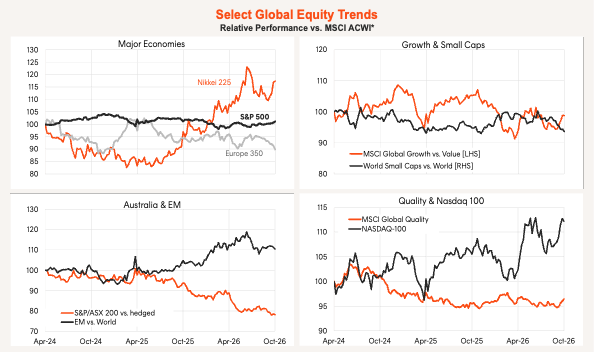
Global technology remained one of the better performing sectors last week, though financials also did well.
The most notable trend of late is the bounce back in the relative performance of technology – along with the US and Japan – in recent weeks.
*All but value factors. Local currency basis. Source: Betashares, Bloomberg.
Australia week in review: weak sentiment
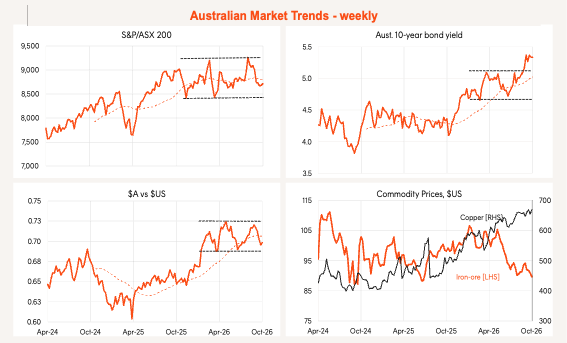
Local stocks edged higher last week, likely dragged up by the improvement in global sentiment.

Source: Betashares, Bloomberg.
The limited local economic news last week was mixed, with an unsurprising slump in consumer sentiment following the RBA’s latest rate hike – yet a feisty further lift in ANZ job advertisements.
Consumer sentiment slumped a further 4.7% in October, with the decline starkly greater among the 40% of respondents surveyed just after the RBA rate hike. Although the link between consumer confidence and household spending is loose, it’s hard to imagine a booming consumer sector given depressed sentiment, reduced housing turnover and the squeeze of incomes from higher interest rates.
ANZ job ads, meanwhile, have been on a rising trend since late last year. Ads rose 2.2% in September to be 16.5% above their recent low in December 2025. But the upturn likely reflects the lagged response to the upturn in economic activity last year. Ads are likely to ease back as and when local economic activity slows under the impact of higher rates and weaker house prices.
It was disappointing to see the float of data-centre hopeful Firmus flounder this week in the face of lukewarm local fund manager support. At issue seemed to be lofty valuations that already seemed to price in flawless long-term execution of an ambitious expansion plan. Limited lock-up of existing investor shares seemed to be another issue. If these were the only issues, it seems a re-packaged float proposal could still proceed, though the latest talk is the company will try to list in the US instead.
Of course, one challenge for local entrepreneurial companies is the May Budget tax changes, which effectively leave local investors facing one of the highest capital gains taxes on high-growth investments in the world.
The tax changes tilt investor incentives toward low-growth dividend-paying companies and encourage entrepreneurs – even if they list locally – to base themselves in competing countries such as New Zealand and Singapore.
Local equity market trends: Defensives favoured
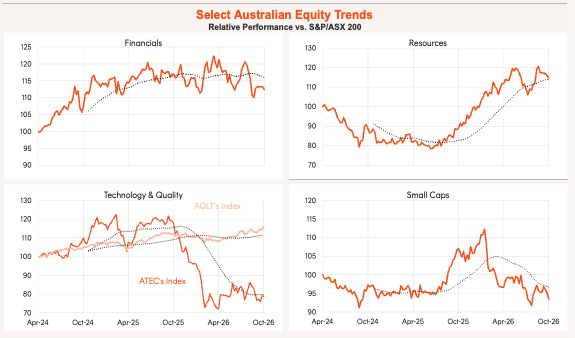
Property, utilities and health care were the better performing sectors last week, while materials and technology slipped back.
In terms of major local trends, the resource sector’s recent outperformance is being challenged by higher global interest rates and the risk to global growth that this entails. If anything, the current macro backdrop favours local defensive sectors.
Source: Betashares, Bloomberg.
Australia week ahead: Labour market report
Two highlights on the local data calendar this week are the NAB monthly business survey (Tuesday) and the official labour market report (Thursday).
The NAB index of business conditions has progressively weakened since its highs of late last year and finally tipped into negative territory in August. After slumping due to the onset of the Iran war, the NAB index of business confidence then rebounded, though has waned again in recent months to remain well into negative territory. It’s hard to see a rebound in either measure in September given ongoing cost pressures and the RBA’s latest rate hike.
Thursday sees the release of the September labour force report, following the “mixed” August report which showed a 39.5k gain in employment yet a lift in the unemployment rate to 4.6%. With monthly employment changes so volatile, and labour supply still firm (due to still solid immigration and rising local labour participation), the best indicator of the health of the labour market remains the unemployment rate.
As it stands, although it has increased over the past year, a 4.6% unemployment rate still leaves the labour market “a little tight” and operating beyond full employment in the RBA’s view.
Accordingly, the RBA would likely be encouraged if the unemployment rate had edged a little higher in September to, say, 4.7%. Indeed, it was only recently that RBA Governor Bullock suggested full employment in Australia would be consistent with an unemployment rate somewhere between 4.5% and 5%.
Have a great week!
