


Riley Terriff
4 minutes reading time


For decades, building wealth in Australia followed a familiar script. Today, that script is being rewritten.
Millennials and Gen Z are navigating a tougher starting point. But they’re also more engaged with their finances than any generation before them, using new tools and strategies to chart their own path forward.
For generations, the path to prosperity was clear: get a job, open a savings account and enjoy a few percentage points of interest a year until you could afford a modest home. Higher savings rates and lower house prices meant an average household income in the 70s and 80s could save up for a 20% deposit on a median home in around two years.
That playbook is no longer possible.
Property prices have grown at more than twice the rate of wages in the last two decades, while post-COVID inflation has added a tidy 23% to the price of everything else since 2020. Today, the average dwelling costs roughly 10 times the average wage so, unfortunately, skipping the avocado toast isn’t going to cut it.
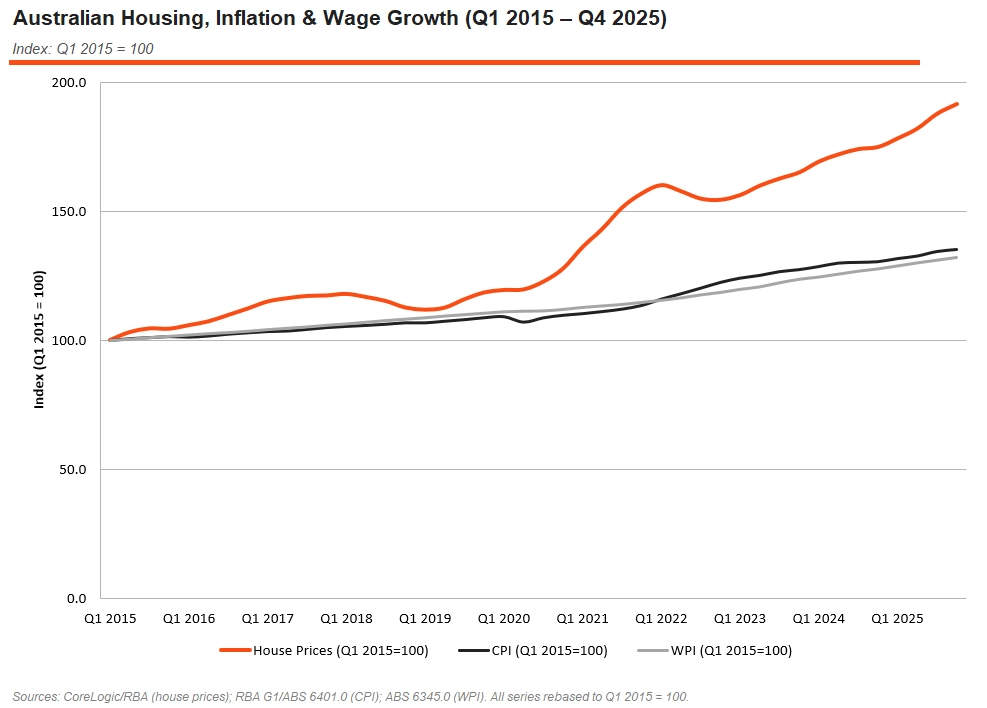
With property ownership out of reach, wages not keeping up with prices and the possibility of entry-level jobs being decimated by AI, young Australians are looking beyond the traditional playbook in pursuit of financial progress.
How young Australians are growing their wealth
Over the past decade we’ve become familiar with the acronym FOMO: Fear of Missing Out. Today, many young people face a different concern: Fear of Being Left Behind.
To keep their wealth growing faster than prices, more young Australians are turning to stock market investing.
A 2024 HSBC study found that 85% of Gen Z and 81% of Millennials had invested in the past six months. This compares to just over half of Gen X and Baby Boomers.
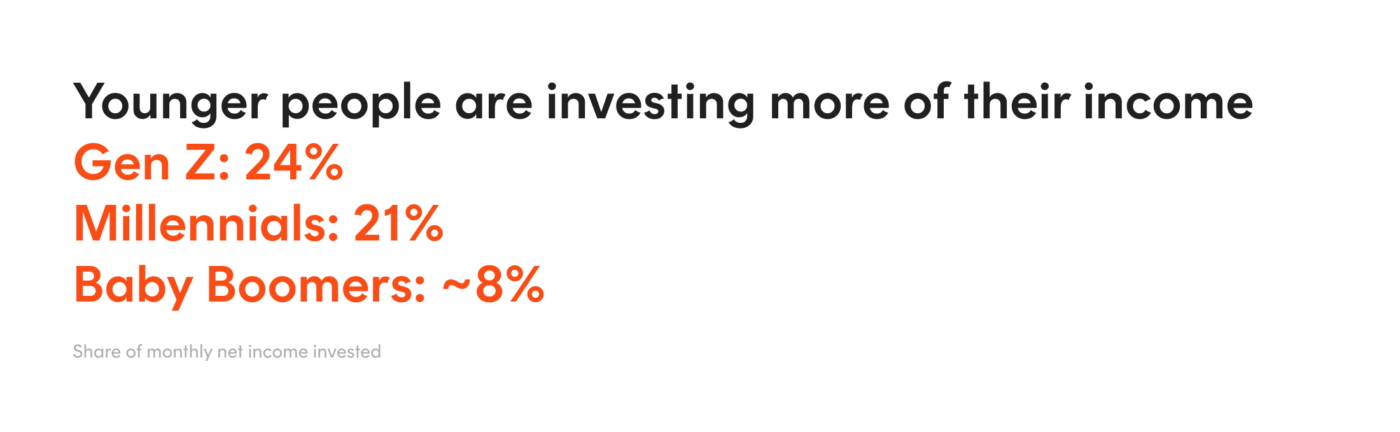
What’s more, they’re investing a larger share of their income. Gen Z and Millennials were investing 24% and 21% of their monthly net incomes, respectively, compared to around 8% for Baby Boomers.
Why are young people investing more than older equivalents? One reason is the changing economic circumstances, as HSBC’s David Talbot explained: “Given this generation is facing challenges accessing the housing market, they are taking it upon themselves to build wealth through methods more accessible to them, and allocating more of their income to do so.”
How are young Australians getting started?
It’s never been easier for young people to learn about investing. There are thousands of podcasts, YouTube tutorials and social media channels dedicated to helping build financial literacy.
It’s also never been easier to start investing. The ASX’s 2023 Investor Study found that the products young Australians are buying are changing.
For older Australians, direct shares remain the preference: 71% of retirees own direct Australian shares compared to 43% of next-generation investors.
Younger investors, however, are gravitating towards ETFs, which offer a simpler and more diversified way to build a portfolio. Just 9% of retirees hold ETFs, compared to 33% of next-generation investors.
Young Australians aren’t abandoning the idea of building wealth. They’re adapting to a world where the old rules no longer apply.
While the path may be less certain, it’s also more flexible. Earlier engagement with investing, greater access to information and a willingness to embrace new tools are reshaping what financial progress looks like.
The real test will come when markets turn, as they inevitably do. But if this generation’s early habits are any indication, many are not just participating, they’re learning how to stay the course.
That’s partly a product of the moment. Platforms like Betashares Direct, a wave of investing podcasts and free online education have made starting accessible in a way it simply wasn’t for previous generations. And for a lot of young Australians, that’s exactly where it begins – just starting.
This information has been prepared by Betashares Capital Limited (ACN 139 566 868, AFSL 341181) (“Betashares”), the issuer of the Betashares Funds and Betashares Invest, the IDPS-like scheme available through the Betashares Direct platform. It contains general information only and does not take into account the individual circumstances, financial objectives or needs of any investor. It is not a recommendation to make any investment decision or adopt any investment strategy. Before making an investment decision, investors should read the PDS and TMD for the relevant financial product and obtain professional advice, available at www.betashares.com.au.