


Hugh Lam
6 minutes reading time


Key takeaways:
- AI adoption is moving from experimentation to production, with the fastest phase of growth likely still ahead.
- Anthropic hits US$30B in annualised revenue, up from $9B at the end of 2025, fuelled by rapid uptake from businesses.
- Results reinforce the investment case for hardware and cloud providers building out next-generation computing infrastructure.
- The Nasdaq 100 is trading at a smaller premium to the S&P 500 than it has in years, supported by strong profit growth.
Not long ago, fears of an AI bubble dominated headlines. Concerns around high valuations, rising debt levels, and the massive cost of building new data centres saw tech share prices fall significantly.
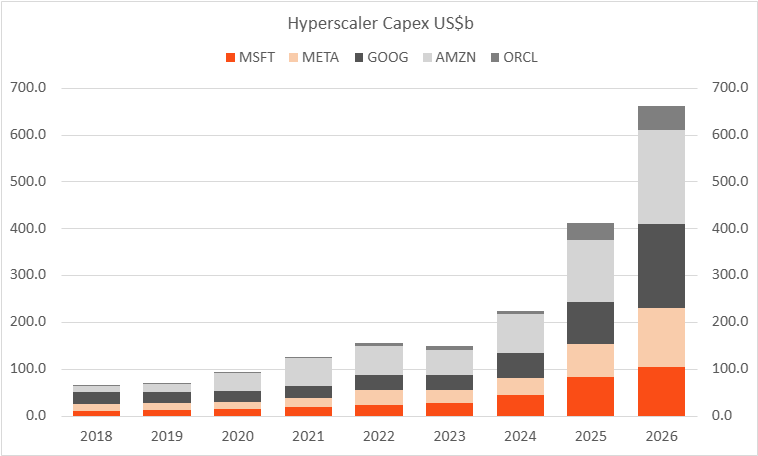
Source: Bloomberg. 2026 figures are estimates.
But as we’ve highlighted in this article late last year, upfront investment outlays are often required before revenues scale exponentially; so the key question is whether this growth would come, and if so, how long it would take?
Fortunately, Q1 2026 results from the mega cap tech companies as a whole were enough to push US share markets (like the S&P 500 and Nasdaq 100) back to all-time highs despite the ongoing war in the Middle East.
- Alphabet was the standout performer despite capex guidance being raised to a range of US$185-$190 billion this year. The insatiable demand for computing power has seen GCP (Google Cloud Platform) revenues soar by more than 60%, hitting US$20 billion for the quarter.
- While Microsoft’s results were also solid with Azure cloud revenue growing 40%, it is not experiencing the same reacceleration as its peers.
- Meta was another casualty with markets penalising its lack of cloud service offering but importantly have seen material ROI (return on investment) benefits with AI. The company experienced a rapid acceleration in top-line revenue growth at higher EBITDA margins (~50%) while average prices per ad rose by 12% year-over-year (yoy).
- Amazon slipped as capital expenditure spending weighed on free cash flows despite AWS (Amazon Web Services) growing 28% yoy, marking the fastest growth rate in 15 quarters highlighting significant reacceleration, while its chip business (Trainium, Graviton) hit a $US20 billion annual run rate.
- Finally, Apple delivered better than expected results with iPhone sales up 22% while the CEO succession announcement of John Ternus is generally being looked upon favourably by markets given his more than two decades experience at Apple and demonstrable working experience with product/hardware design.
Beyond the overall robust results across these publicly listed megacap tech companies, we are also seeing positive developments with private companies such as Anthropic, the creator of Claude.
Anthropic surpasses OpenAI in annualised revenue
Perhaps the best proof point happened last week when Anthropic announced it reached US$30 billion in annualised revenue – up from just $9 billion at the end of 2025.
That’s more than triple in the space of just three months, with growth driven by businesses rapidly adopting AI, with now over 1,000 companies paying over $1 million annually for Anthropic’s latest models.
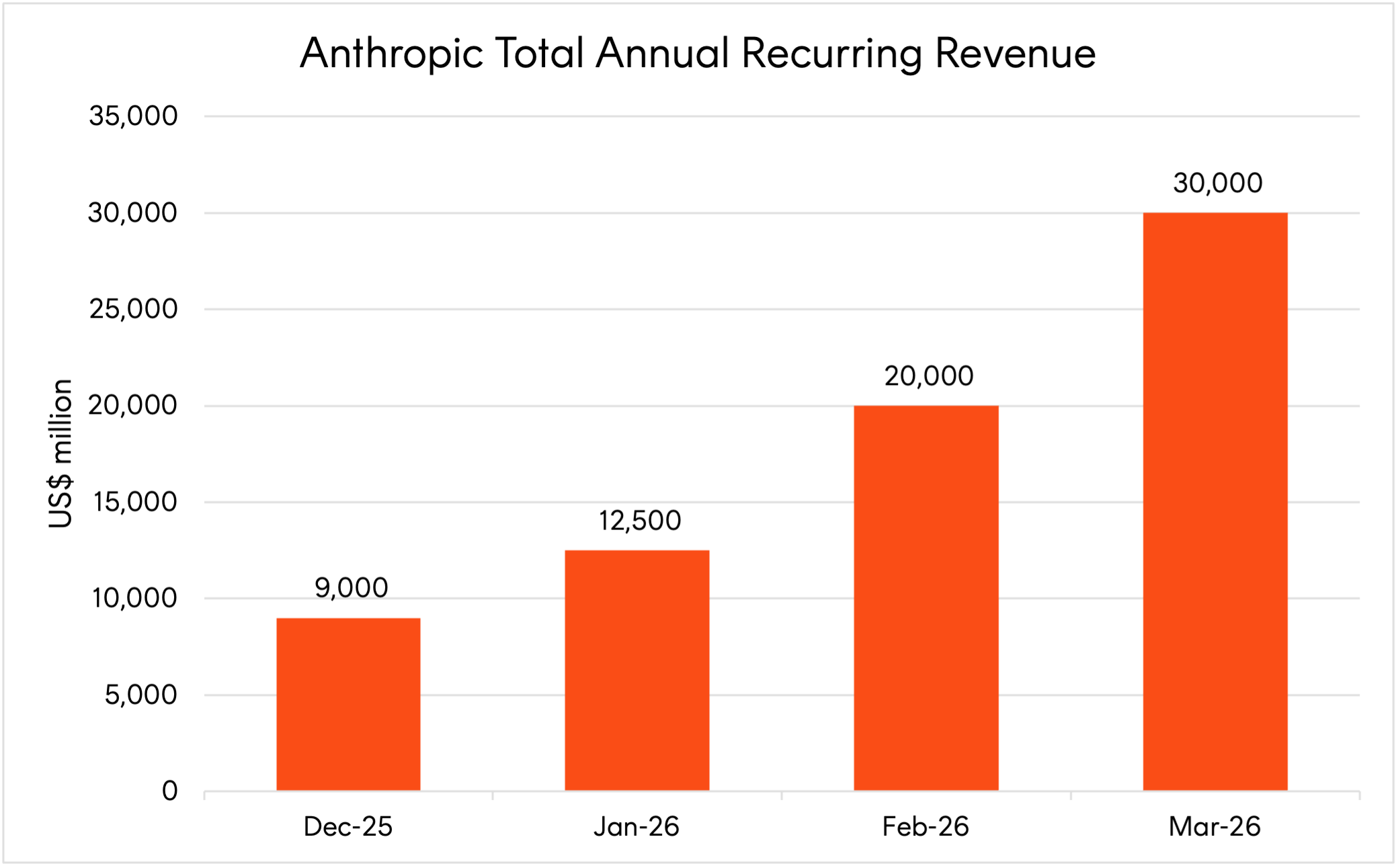
Source: Altimeter Capital Management estimates, Anthropic Press Release
To put into context how fast this achievement is, Google only crossed the $30B revenue threshold when it had ~110,000 people. Anthropic achieved this milestone with ~2,500 employees and just ~1.5-2 gigawatts of compute capacity1. All else equal, that should bode well for improving profitability as the company grows.
And with AI agents becoming a legitimate solution to solve real business problems, there will likely be more companies embedding Anthropic models into their products and services. In other words, companies are moving past the ‘testing’ phase and putting AI to work at scale.
The outlook for continued revenue acceleration remains bright given we have not yet reached the steepest part of the technology adoption curve – the phase where growth typically accelerates fastest – with business AI usage still in early stages.
The outlook for US tech
Anthropic’s result is a vote of confidence to the broader AI ecosystem and so far, validates the billions that the largest tech companies have been spending on data centre infrastructure.
The US Information Technology sector is expected to report the strongest profit growth of any sector for the first quarter of 20262 for Q1 2026, led by companies in the semiconductor industry.
Abroad, Samsung, a leading memory chip maker, reported a dramatic jump in quarterly profit, while Taiwan Semiconductor is set to report earnings later this week with analysts expecting AI-related revenues to more than double.
Beyond strong fundamentals, valuations look more reasonable, with the Nasdaq 100 trading at a lower premium to the S&P 500 than at any point since 2018. A large part of this shift has been driven by the Nasdaq 100’s stronger profit growth over recent years.
Source: Bloomberg. As at 15 April 2026.
Additionally, the Nasdaq’s new fast entry rule could also allow major companies going public (known as IPOs), such as potential listings from Anthropic, OpenAI, and SpaceX, to join the index just 15 trading days after listing.
Looking forward, investors will remain attentive to how profitability improves, particularly for AI research labs like Anthropic given the scale of infrastructure spending required. That said, this is a positive development for leading hardware providers such as Google and Broadcom they are building the latest generation of specialised AI chips (known as TPUs), set to provide Anthropic around 3.5 gigawatts of compute capacity starting in 2027.
With the Nasdaq 100 trading at fairer valuations, and evidence of AI monetisation already before us, current valuations may appear more attractive compared to recent years for those considering exposure to the technology sector.
Sources:
1. Altimeter Capital ↑
2. https://www.factset.com/earningsinsight ↑