



This information is for the use of financial advisers. It must not be distributed to retail clients.
Key points
Over the last week, jitters around the sustainability of AI capex and how it is being funded drove a reversal in tech-related companies and markets.
Neocloud operator CoreWeave fell nearly 30% in a single session as yields on its 2031 bonds surged to more than 15% while data centre operator Firmus withdrew what was set to be one of Australia’s largest share market floats. AI-linked equity markets such as the Nasdaq 100, Japan’s Nikkei 225 and South Korea’s KOSPI also felt the pain with the latter one of the worst performing regions down 16.4%1 for the week.
Financing constraints are emerging as a real bottleneck to the development of AI given the increasing reliance on debt and equity issuance to fund massive data centre builds. More complex financing arrangements such as circular vendor-customer relationships and off-balance sheet commitments are increasingly being used, which raises the risk of a correction should interest rate volatility and levels increase from here.
While financing markets are tightening, a higher cost of capital may not necessarily be a bad thing for long term returns with less indebted companies more insulated than those relying on cheap funding and rising valuations.
Indeed, the credit market is highlighting this difference with Oracle’s credit default swaps much wider than the broader investment grade technology sector. Spreads across other US large cap tech issuers show a similar divergence.
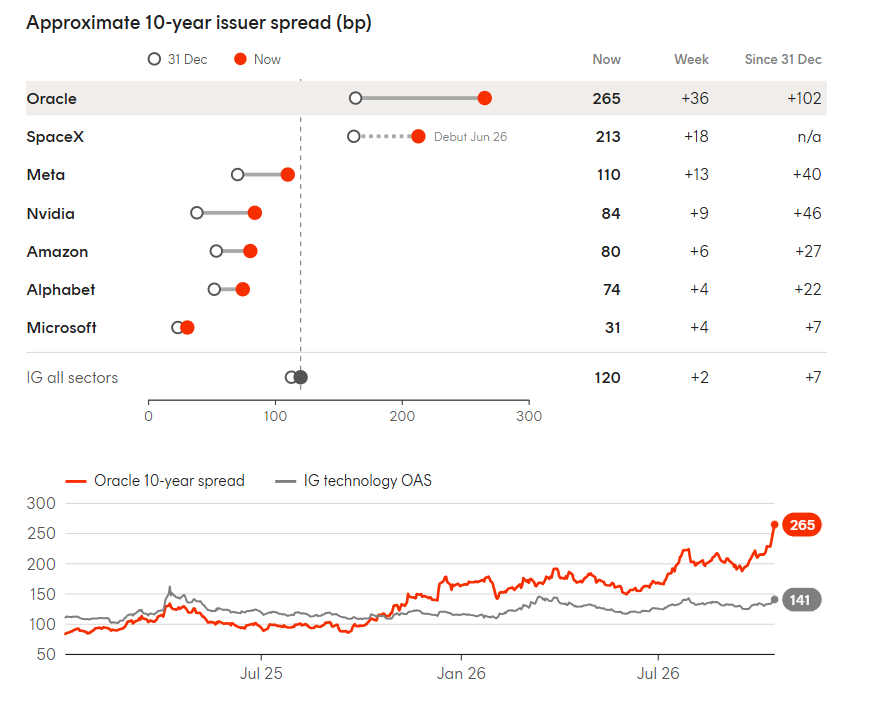
Source: Bloomberg, Betashares. Senior USD fixed-rate bond yields interpolated to 10 years remaining, less the 10-year US Treasury yield; a cash-bond spread proxy, not OAS, so the IG all-sector OAS row is an indicative reference. SpaceX is shown from its June 2026 debut.
In our view, AI financing concerns in themselves are unlikely to derail the equity market while earnings continue to deliver but will likely create pockets of volatility in leveraged exposures like neocloud operators.
Corporate earnings look strong but what’s happening underneath the surface?
Ultimately, the health of corporate earnings is a key driver of long term equity market returns.
Third quarter earnings for the S&P 500 are expected to grow 30.7%, in large part supported by the semiconductor industry within IT. Much of this stems from AI capex spending with a large share of that spending still being funded from the operating cash flows of the largest hyperscalers, Oracle aside.
The only other sector growing earnings faster than IT is Energy due to higher year over year oil prices but even excluding this sector, the S&P 500 is still growing earnings at 26.2%.
| Sector | Earnings $B – 26Q3 | Earnings $B – 25Q3 | Growth $B – 26Q3 | Growth % – 26Q3 |
|---|---|---|---|---|
| Consumer Discretionary | 56.2 | 54.3 | 1.9 | 3.5% |
| Consumer Staples | 33.8 | 32.6 | 1.2 | 3.7% |
| Energy | 58.6 | 25.7 | 32.9 | 128.3% |
| Financials | 121.3 | 114.9 | 6.4 | 5.5% |
| Health Care | 72.3 | 71.5 | 0.9 | 1.2% |
| Industrials | 51.2 | 43.4 | 7.8 | 18.1% |
| Materials | 15.7 | 11.9 | 3.8 | 31.5% |
| Real Estate | 14.7 | 14.2 | 0.6 | 3.9% |
| Information Technology | 256.6 | 154.1 | 102.5 | 66.5% |
| Communication Services | 70.5 | 48.3 | 22.2 | 46.1% |
| Utilities | 23.0 | 21.5 | 1.4 | 6.7% |
| S&P 500 | 773.9 | 592.3 | 181.6 | 30.7% |
| S&P 500 ex-Energy | 715.3 | 566.6 | 148.7 | 26.2% |
Source: LSEG I/B/E/S. As at October 16, 2026.
Earnings breadth remains narrow due to the strength of tech but there are signs of broadening with analysts predicting the Magnificent 7 companies will report lower earnings growth than the other 493 S&P 500 companies (23.6% vs. 30.6%) for the next quarter (Q4) which would mark the first time since Q4 20222.
Financing concerns are a potential contributor with names like Nvidia indirectly exposed through its equity stakes in CoreWeave and Nebius, although these are small relative to its market capitalisation.
Tighter financing could also pressure cloud revenue growth at hyperscalers such as Oracle and Microsoft, given a meaningful share of their contracted backlogs is concentrated in AI labs (namely OpenAI).
Despite these risks, analysts expect leadership to remain with technology, with IT earnings forecast to grow 41.8% in calendar year 2027. It’s worth noting that the other 493 companies include AI beneficiaries such as Broadcom, Micron and AMD so some of this broadening reflects AI spending flowing through the supply chain. Beyond tech, Health Care (23.0%) and Industrials (16.3%) are expected to grow in line with or ahead of the index.
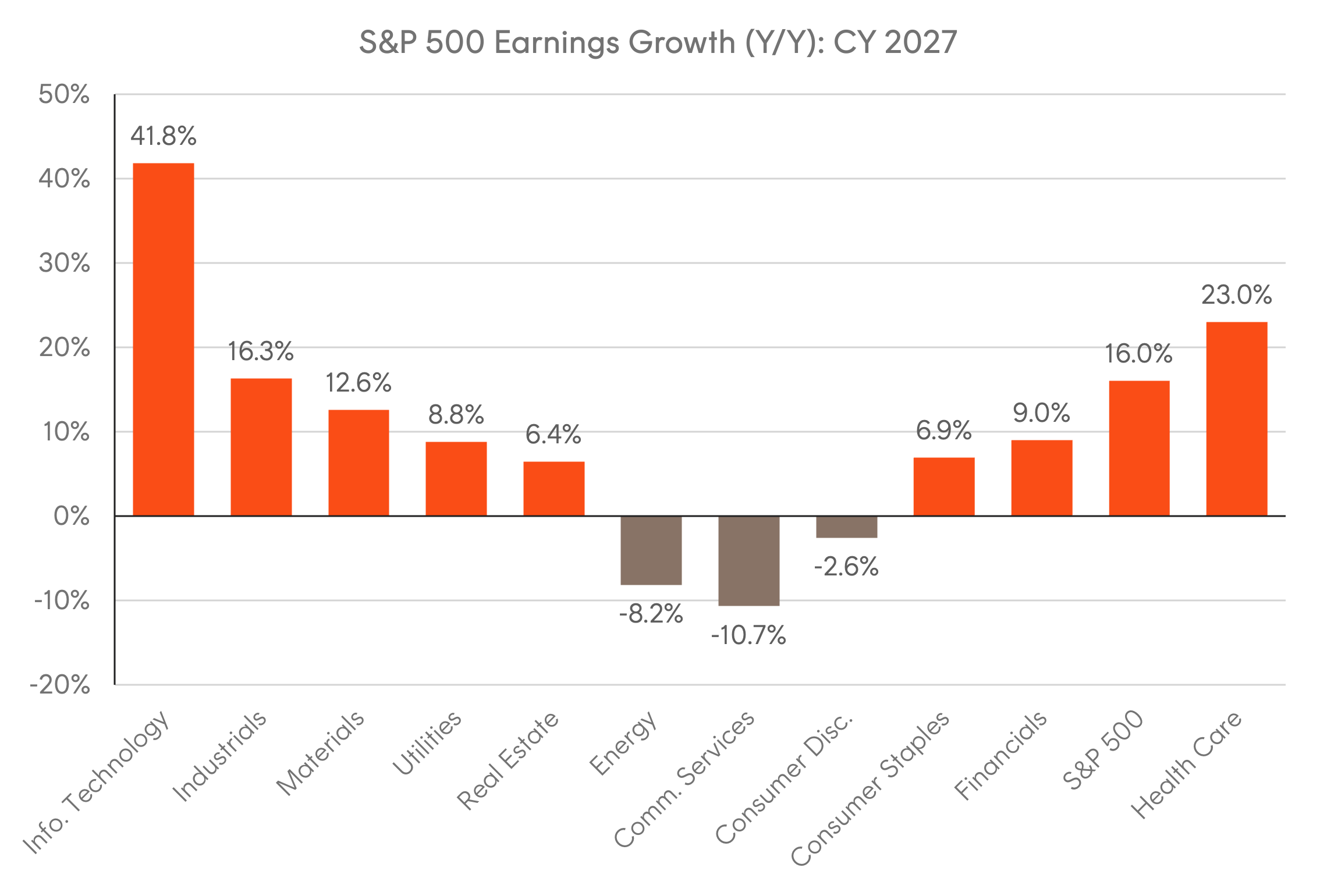
Source: FactSet. As at October 16, 2026.
What are we looking out for?
Last week’s price declines reflect real financing risks but may create opportunities in businesses with resilient earnings prospects. In our view, the structural case for technology remains intact and makes it difficult to ignore the earnings strength of diversified, core exposure like the NDQ Nasdaq 100 ETF.
However, the risk-reward has shifted with financing conditions having the potential to slow capex growth and moderate the pace of earnings upgrades. Broadening exposures such as the QUS S&P 500 Equal Weight ETF or EXUS Global Shares Ex US ETF can complement a broad US market cap weighted exposure like NDQ as earnings leadership widens.
Overnight, we will be watching Meta earnings and guidance on their 2027 capex and whether spending moderates relative to revenue growth, alongside free cash flow and its funding mix. Beyond earnings, we continue to monitor movements in credit spreads across AI-exposed issuers and the Federal Reserve’s 27–28 October meeting which will shape the rates backdrop for the remainder of the quarter.