

Key points
Major selling across global equity markets, centered on the artificial intelligence trade, unnerved investors last week, before Jensen Huang’s return as Nvidia CEO sparked a sharp rebound on Monday. This note reviews what drove the sell-off, what the rebound does and does not resolve, and where to from here.
What happened last week?
Last Friday capped a rough week on Wall Street. The S&P 500 fell 8.6% over the week, with the tech-heavy Nasdaq 100 down 10.4%. The decline left the S&P 500 11.6% below its record high of 6 October, and officially in “correction” territory. The Nasdaq 100 was down 19.8% from its peak.3
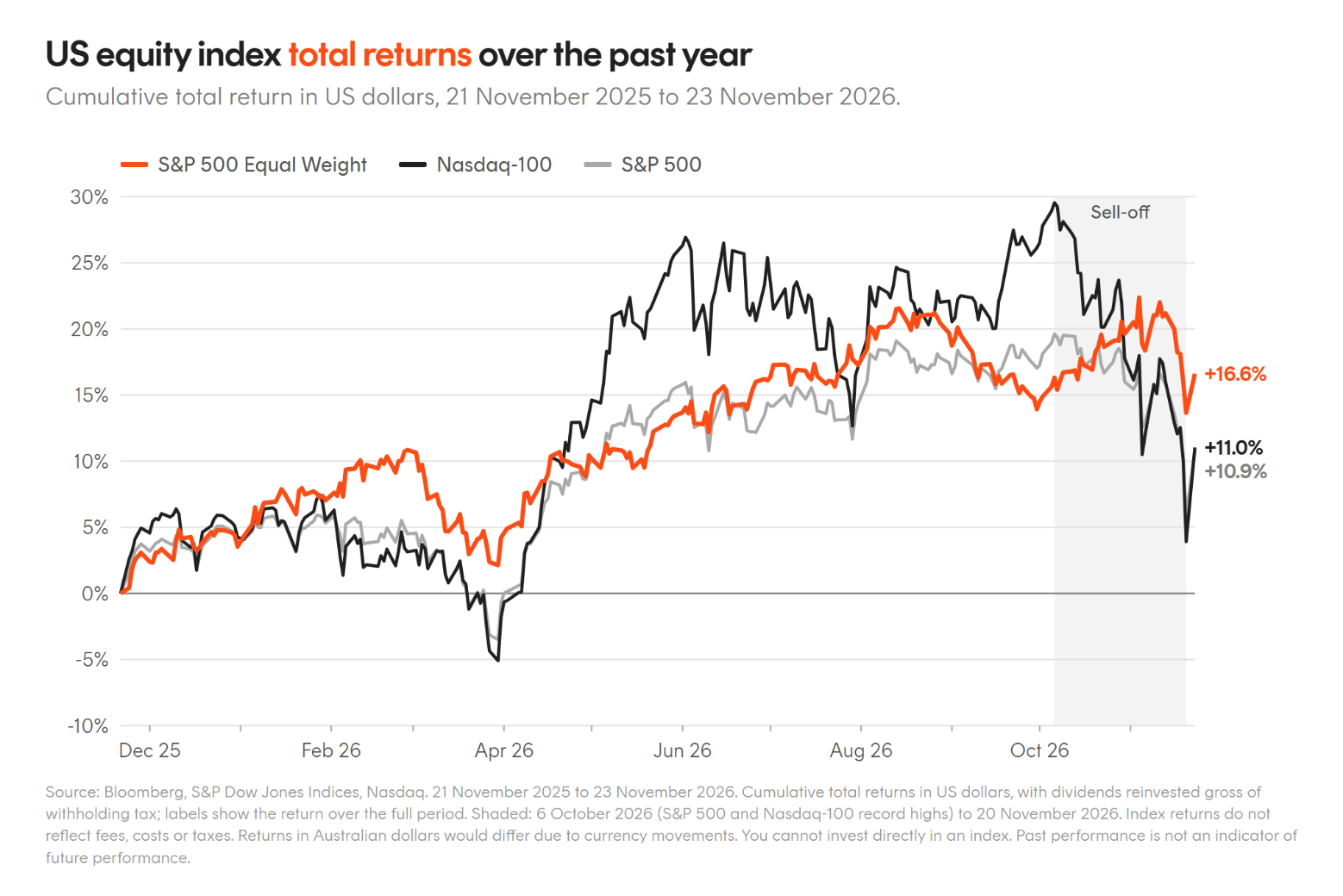
Yet the damage has been concentrated. The equal-weight version of the S&P 500, which gives every company the same weight, is down just 2.3% since 6 October4. In general, areas of the global equity market less exposed to major AI companies – including Australia – have held up relatively better.
Why?
The AI sell-off reflected a coalescence of three key factors overhanging the market: fears around the AI buildout, Nvidia’s internal problems and the risk of further rate hikes from the US Federal Reserve.
The AI buildout. Ever since the launch of ChatGPT in late 2022, there has been a mad scramble among global tech companies to build data centres to facilitate learning and inference by resource-intensive large language models (LLMs). This surge in investment has underpinned a surge in profits among chip makers and cloud computing providers. It has, however, also eaten into the free cash flows of the hyperscalers, who have increasingly needed to issue more debt and equity for funding.
There are two concerns around the buildout.
First, that it will end sometime soon, especially given the rising cost of investment funding and increased regulatory scrutiny in the wake of the US Democrats’ strong showing in the recent midterm elections. The fear is a wind-down in the investment boom will lead to a wind-down in the profits boom, which has heavily supported the gain in global equities over recent years.
A second – but somewhat conflicting – concern is whether the investment boom has been excessive, and unlikely to earn companies in the AI ecosystem a decent return on investment.
Nvidia’s internal problem. With a near-monopoly on the chips required to power the AI boom, Nvidia has been at the epicentre of the AI ecosystem in recent years. It has not only provided chips to the established hyperscalers but helped fund a myriad of smaller players in the industry, such as the so-called “neo-clouds”. The departure of Nvidia’s longstanding CEO Jensen Huang had led to a myriad of concerns, such as whether the investment in other players in the AI industry will continue and/or whether US national security grounds will now result in reduced chip supply and data centre construction in the Asian region.
The Fed. The last concern is a rising fear that the US Federal Reserve may need to raise short-term interest rates aggressively further to contain inflation. In part, this is AI related – the AI investment boom has added to both US economic growth and pricing pressure. At present, the market fully expects another Fed rate hike next month, and several more in 2027.
Further US rate hikes pose several risks, such as weakening US economic growth and raising the cost of AI-related debt funding.
Huang’s return
On Monday, Jensen Huang’s return as CEO, sparked a sharp relief rally. Nvidia’s market value jumped 31% in a day and the rally spread across the AI trade, with the Nasdaq-100 up 6.9% and the S&P 500 up 4.7%. The rebound helped stabilise sentiment towards the broader AI theme. Markets are now betting Huang will resume backing capital-constrained neoclouds that rely on Nvidia’s balance sheet to underwrite their buildouts.
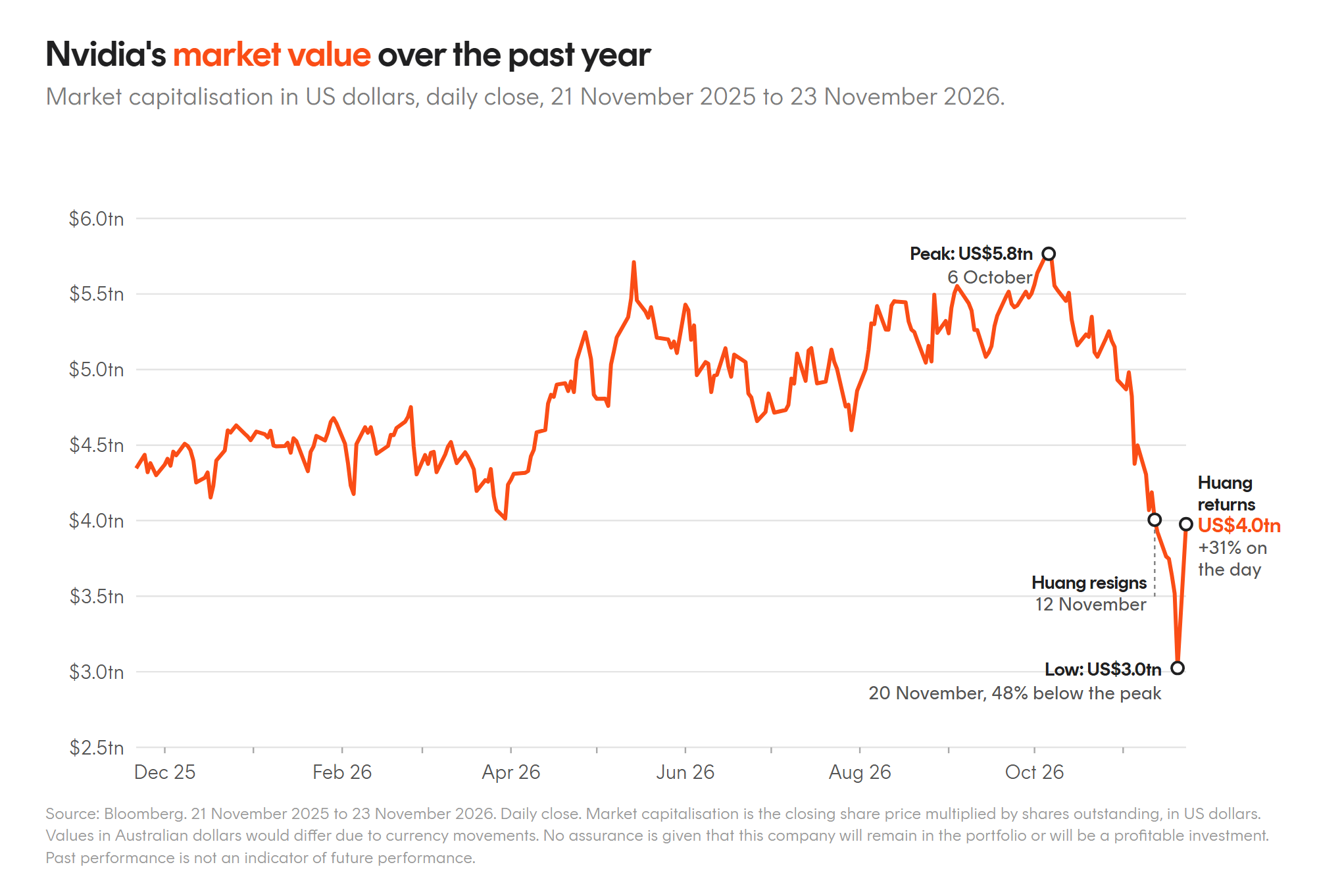
However, the sustainability of the rally will depend on more than Huang’s return. While Nvidia’s fundamentals remain exceptionally strong, with revenue doubling year on year5, investors still have to price ongoing export control investigations, uncertainty over China sales and governance questions that hang over Huang. Huang will face a Senate hearing on the 3rd of December testifying on export controls and recent leadership controversy.
Other parts of the AI ecosystem, beyond Nvidia and the other chip stocks, need to fire. Investors will be looking for signs of continued strong cloud revenue growth and margins from the Hyperscalers, monetization from frontier labs like Anthropic, and ultimately growing adoption and productive gains of use users of AI and AI enabled application software.
Where to from here?
The main near-term market concern is a curtailment of the AI investment boom, as this poses a direct risk to the associated boom in corporate profits. Yet it’s not clear the AI investment boom will end any time soon and, even if there were some moderation, this may offer some blessings in disguise.
With appetite for AI services continuing to ramp up rather than slow down, there appears to be little reason to expect an imminent investment slowdown. According to Goldman Sachs estimates, US hyperscaler capital spending will reach US$1.2 trillion next year, up around 50% on 2026 levels, and rise a further 16% in 2028 to US$1.4 trillion.6 Consistent with this still-buoyant investment outlook, US earnings growth expectations also remain upbeat, with 17% growth in forward earnings by the end of next year7. The rate of AI investment will eventually slow down, though this should lead to a slowdown rather than collapse in corporate profits.
With the S&P 500 and Nasdaq 100 already down around 10% and 20% from their peaks respectively, a good deal of risk has now arguably already been priced into the market. The S&P 500 ended last week trading at 16.5 times forward earnings, compared to a recent peak of 23 in October 2025 – and below its 10-year average of 19.8
Indeed, it is rare for major equity indices such as the S&P 500 to fall a lot lower, barring the onset of a US recession. And powered by the AI boom, the US economy is still growing nicely and far from recession.
Of course, interest rate and regulatory risk will persist as we head into 2027. To the extent the AI investment boom moderates, however, this may well lessen the need for further Fed rate hikes – and could lead to rate cuts. If oil prices continue to ease that will also help. Furthermore, a more moderate AI investment rollout could also lessen pressure on hyperscaler balance sheets and slow the potential disruption AI poses to many existing tech companies.
Investment implications
If the recent market sell-off proves to be merely a market correction, rather than the start of a drawn-out bear market associated with US recession, investors could consider the NDQ Nasdaq 100 ETF – and its currency-hedged counterpart HNDQ Nasdaq 100 Currency Hedged ETF. Both provide exposure to the Nasdaq 100, which is concentrated in large technology and growth companies. Investors expecting a rebound in sentiment toward the AI sector may also consider the ASIA Asia Technology Tigers ETF.
For those investors who remain confident in the US economic outlook, but want to reduce their exposure to Wall Street’s current heavy technology concentration, a more diversified option would be the QUS S&P 500 Equal Weight ETF. As its name implies, this ETF weights each stock in the S&P 500 index equally, dramatically reducing its exposure to the large cap hyperscalers that currently dominate the market.
Of course, one upside of the current risk-off environment is that fixed-rate bonds have once again proven to be a handy port in a storm. Despite Fed tightening fears, long-term bond yields have fallen notably in recent weeks, providing investors with decent offsetting capital gains in diversified multi-asset portfolios. For those concerned that market and economic outlook could deteriorate, this opens up the possibility of central bank interest rate cuts. A useful defensive option to consider under this scenario would be a broad Australian composite fixed-rate bond ETF (OZBD Australian Composite Bond ETF), providing exposure to a broad range of Government and corporate fixed-rate bonds.