

Key points
Investing in the AI theme has just become a lot more complicated.
Markets continue to reckon with the potential investment implications of the US midterm election results where Democrats won full control of Congress. Nvidia delivered a strong result today, lifting its revenue growth forecast to 75%. But CEO Jensen Huang’s resignation, following revelations of extramarital relationships, has wiped nearly US$1 trillion from the company’s market capitalisation.
Together, these developments have led to a sell-off in US equity indices as investors reassess expectations as to how and where the AI trade will evolve from here. A Democrat Congress is being viewed as a net negative to the data centre infrastructure build given the widely held view that more regulation will rein in capital expenditure growth. On Nvidia, the departure of CEO and Founder Jensen Huang was a black swan event that puts into question the future of the world’s largest company without its visionary leader.
While the ‘AI trade’ is undoubtedly under pressure, it shouldn’t be viewed as a singular exposure that moves in unison. For example, hyperscalers have proved more resilient than their neocloud counterparts given they are building their own custom silicon chips.
This reinforces the case for a more diversified approach across the AI value chain and serves a reminder that even the largest companies in the world are not immune to idiosyncratic risks.
Where are we in the AI cycle?
The AI cycle is maturing with the build out being increasingly funded by debt and external capital. Several hyperscalers including Meta, Alphabet and Amazon reported negative free cash flow during the third quarter US earnings season which saw their share prices punished, while Microsoft was spared.
However, the midterm election results could alleviate pressure on hyperscaler free cash flows as more regulation and costs would lead to a delay, rather than outright cancellation, of compute infrastructure buildouts which in turn makes capex growth more sustainable. Additionally, we see compute capacity further out in 2028 onwards being more vulnerable to permitting delays rather than near term projects which are already under construction.
Despite the potential regulatory headwinds, underlying compute demand remains strong with demand exceeding supply. AWS capacity is sold out for 2026 and largely for 2027 and hyperscaler cloud revenue growth continues to accelerate at a rapid pace.
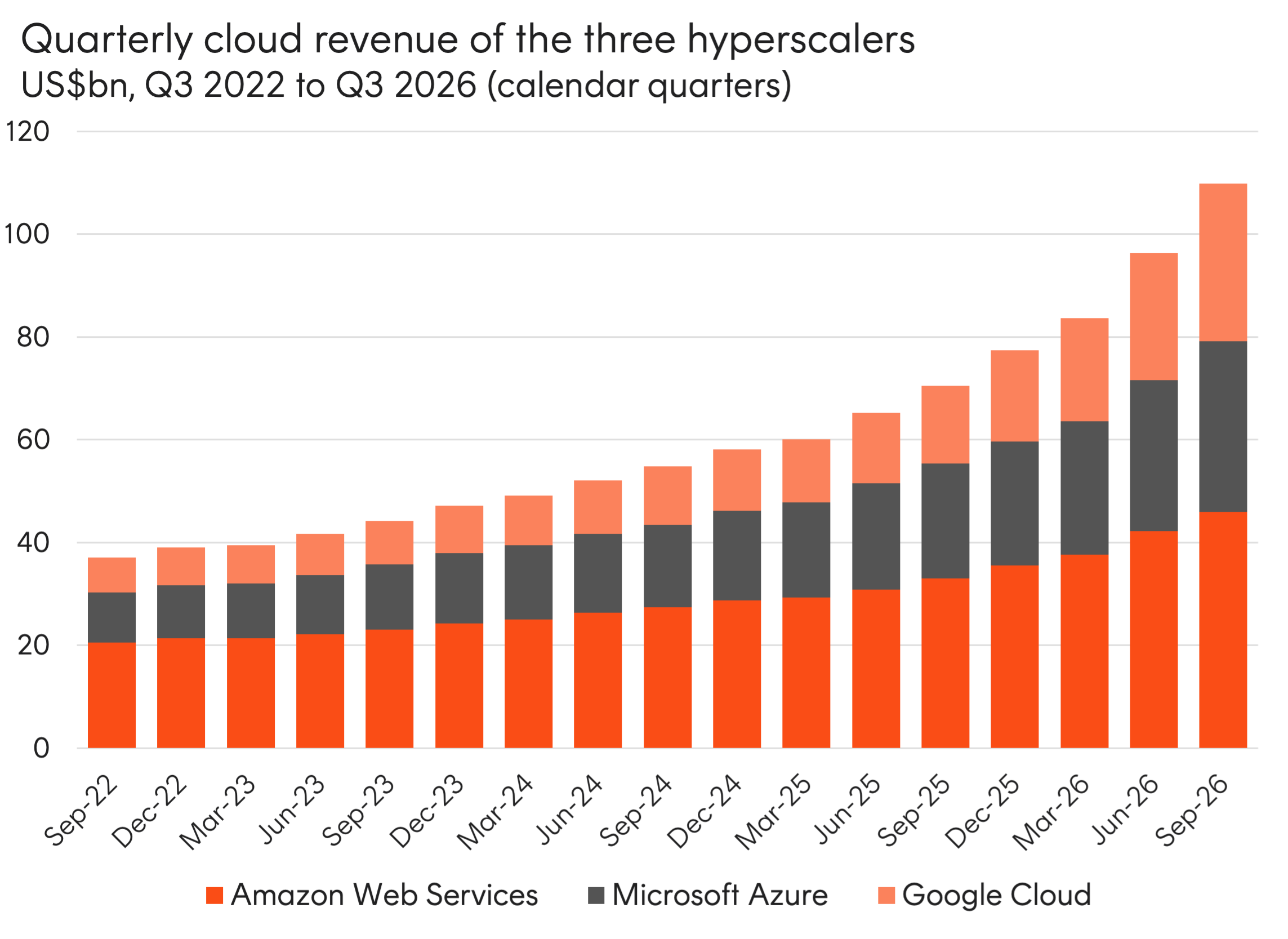
Source: Company reports, Goldman Sachs. September 2022 to September 2026. Microsoft’s September quarter shown as Q3; Azure on Microsoft’s restated basis from Q3 2024, prior basis (Azure and other cloud services) before that.
What are the key risks to the AI theme?
A key risk to the AI theme is Nvidia’s growing role in providing financial backstops and customer financing to its own customers, particularly the neoclouds. If funding for these operators dries up, so too could a meaningful source of Nvidia’s orders and upstream semiconductor suppliers. However, less neocloud funding may hand greater pricing power to the hyperscalers that already dominate compute supply.
Pressure on Nvidia also does not necessarily mean pressure across the entire semiconductor layer, with the likes of AMD and Micron potentially benefiting as customers diversify their suppliers.
Further risks lie in the credit markets where tighter conditions would force weaker neocloud operators to cut spending, which would again ripple through to the chipmakers and data centre suppliers that depend on their orders. This stress could also have a broader reach than many investors realise, with AI-related debt issuance now equivalent to around 30% of US Treasury issuance1.
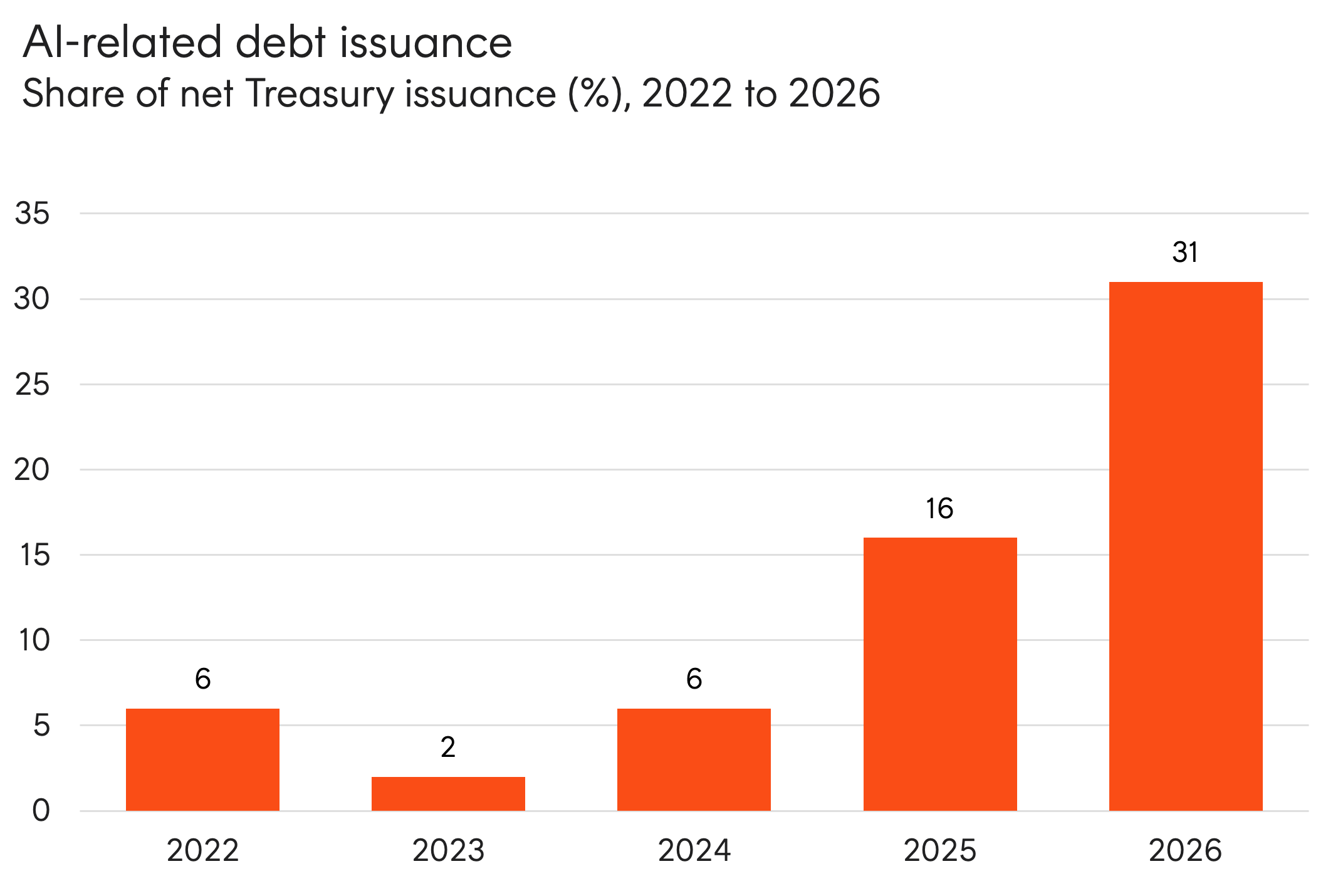
Source: Green Street, BCA Research. Calendar years 2022 to September 2026.
Equity markets are also being asked to absorb a growing wave of supply. In June, Alphabet announced an upsized ~US$85bn equity raise in the same month as SpaceX’s record US$86bn IPO. Anthropic is now offering 825 million shares, with a further ~1.6 billion existing shares potentially eligible for sales as lock-ups expire through early February 2027, roughly twice the size of the offer.
Notwithstanding these concerns about access to capital, highly rated hyperscalers continue to access bond markets on relatively supportive terms, and Anthropic’s IPO is reportedly close to seven times oversubscribed.2 Some investors may view the current share price weakness across the AI ecosystem as a potentially attractive entry point.
Investing across the AI value chain: Betashares Artificial Intelligence ETF (ASX: CHAT)
Investing in AI may have become more complicated, but the theme has become more nuanced as each layer of the five-layer cake, a metaphor popularized by Jensen Huang to describe the AI supply chain, evolves.
Regulatory uncertainty following the midterms, leadership upheaval at Nvidia and tighter financing conditions are weighing on parts of the AI complex, yet their impact is uneven across the value chain.
Hyperscalers building their own custom silicon have proved more resilient than debt-reliant neoclouds, while pressure on Nvidia may open the door for other chipmakers such as AMD and Micron.
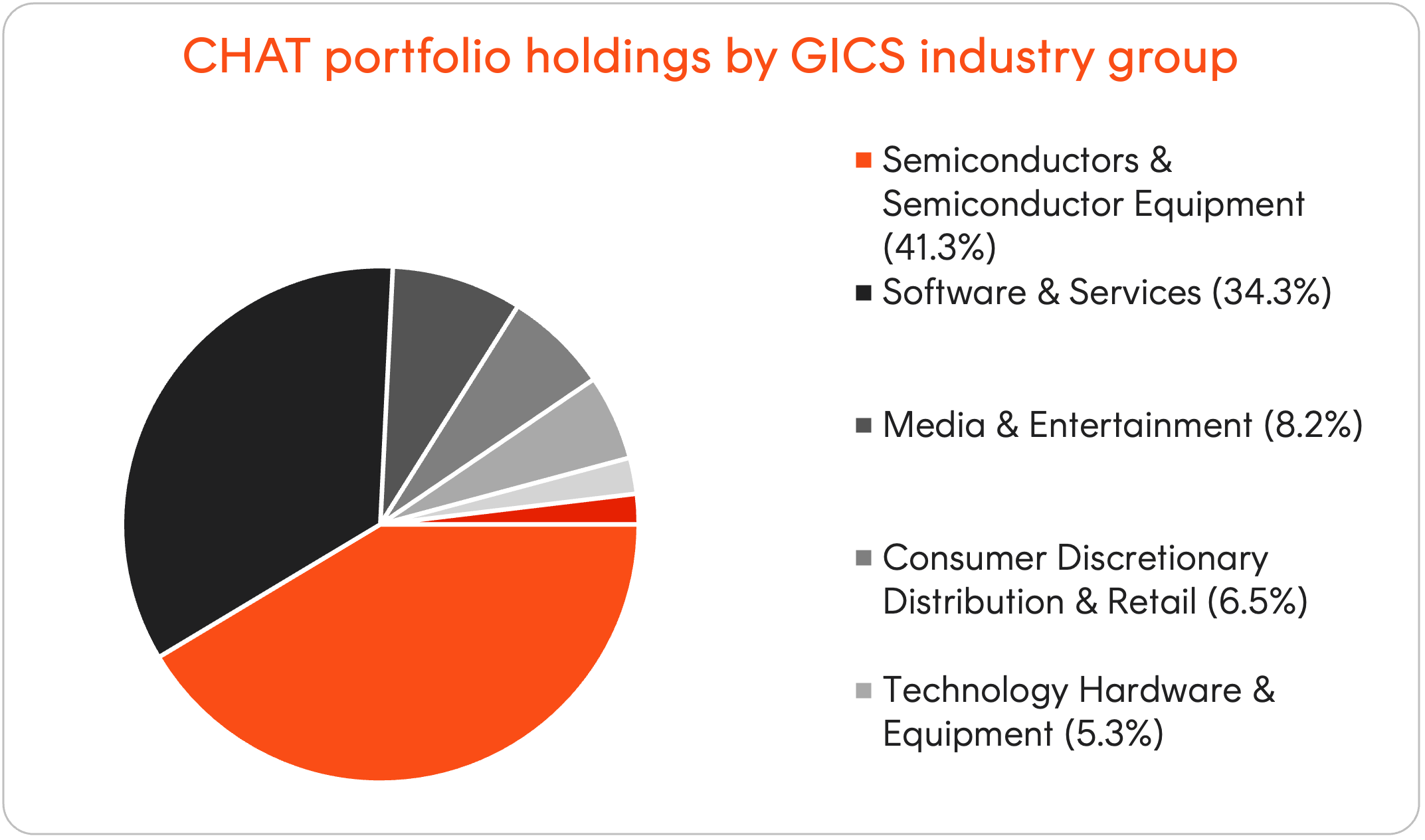
Source: Betashares. Constituent weights by Global Industry Classification Standard (GICS) Level 2 industry group as at 16 November 2026. You cannot invest directly in an index.
The recently launched CHAT Artificial Intelligence ETF provides exposure to around 50 companies across the AI ecosystem, from the companies designing and making semiconductors to providers of compute infrastructure, model developers and AI software. Diversifying across different layers of the AI supply chain allows investors to capture the evolving AI theme, without relying on any one company or segment to deliver.
AI is a multi-year structural theme, but the path is unlikely to be smooth from here. There is upward pressure on demand for capital to fund capex and the leaders across the value chain may change. That argues for a more diversified exposure rather than a concentrated bet on a single layer or company. CHAT may suit investors seeking a targeted satellite allocation to AI alongside a well-diversified core portfolio of equities, bonds and other assets.