Rethinking value investing | Betashares
About
Loading
This content is for financial adviser use only.
By clicking on 'Financial professional', you certify that you are an Australian financial services licensee or authorised representative, and are authorised to provide personal advice to retail clients in relation to managed investment schemes.
Home
keyboard_arrow_down
chevron_right
Insights
keyboard_arrow_down
chevron_right
Rethinking value investing
keyboard_arrow_down

Rethinking value investing

8 min read • 4 Nov 2026

This information is for the use of financial advisers and other wholesale clients only. It must not be distributed to retail clients.

Key takeaways

Key points

01
Traditional value strategies focus on a narrow group of “cheap” stocks and have had extended periods of underperformance. Fundamental value instead selects and weights the largest companies by the size of their underlying businesses.
02
Since May 2013, GVAL’s index captured on average 89% of traditional value’s upside but only 66% of its underperformance, and outperformed MSCI World Value by 2.3% p.a.1
03
GVAL can sit alongside a market capitalisation weighted portfolio or serve as a targeted value allocation. With its launch, Betashares now offers an ETF for each of the quality, value and momentum factors in both Australian and global markets.

Rethinking value investing

Traditional value strategies have often focused on a narrow group of companies identified as “cheap” using valuation measures such as price to book, price to earnings and dividend yield. However, in recent years, these strategies have experienced extended periods of underperformance as other parts of the market have driven returns.

Fundamental value takes a broader approach by selecting the largest companies in the relevant sharemarket based on the size of their underlying businesses, rather than focusing only on stocks that appear cheap under conventional valuation metrics. It then weights them according to their fundamental value.

Having managed the QOZ Australia 200 Fundamental Value ETF for over a decade, we are proud to launch the GVAL Global Fundamental Value ETF, which provides exposure to global developed markets excluding Australia.

The fundamental value approach

Rather than selecting only stocks that look cheap on conventional measures, a fundamental value strategy selects the largest companies in its market by the size of their underlying businesses, or fundamental value, and weights them by that same measure. Fundamental value uses four complementary measures:

  • Sales: 5-year average sales
  • Cash flow: 5-year average cash flow plus 5-year average R&D expense
  • Book value: latest book value plus R&D expenses capitalised over 5 years
  • Dividends: 5-year average dividends plus buybacks

Together these capture different dimensions of business size and reduce reliance on any single accounting measure. Including R&D recognises intangible investment as a significant part of a modern company’s business.

At each scheduled rebalance, the strategy generally reduces exposure to companies whose share prices have become expensive relative to their fundamentals and increases exposure to those that have become cheaper. The result is a broadly diversified portfolio with a distinct value tilt. It can still hold companies not traditionally classified as value stocks, tilted to reflect their fundamental size.

Overcoming value’s periods of underperformance

Fundamental value’s broader approach to value investing is intended to provide a more balanced return profile across different value environments.

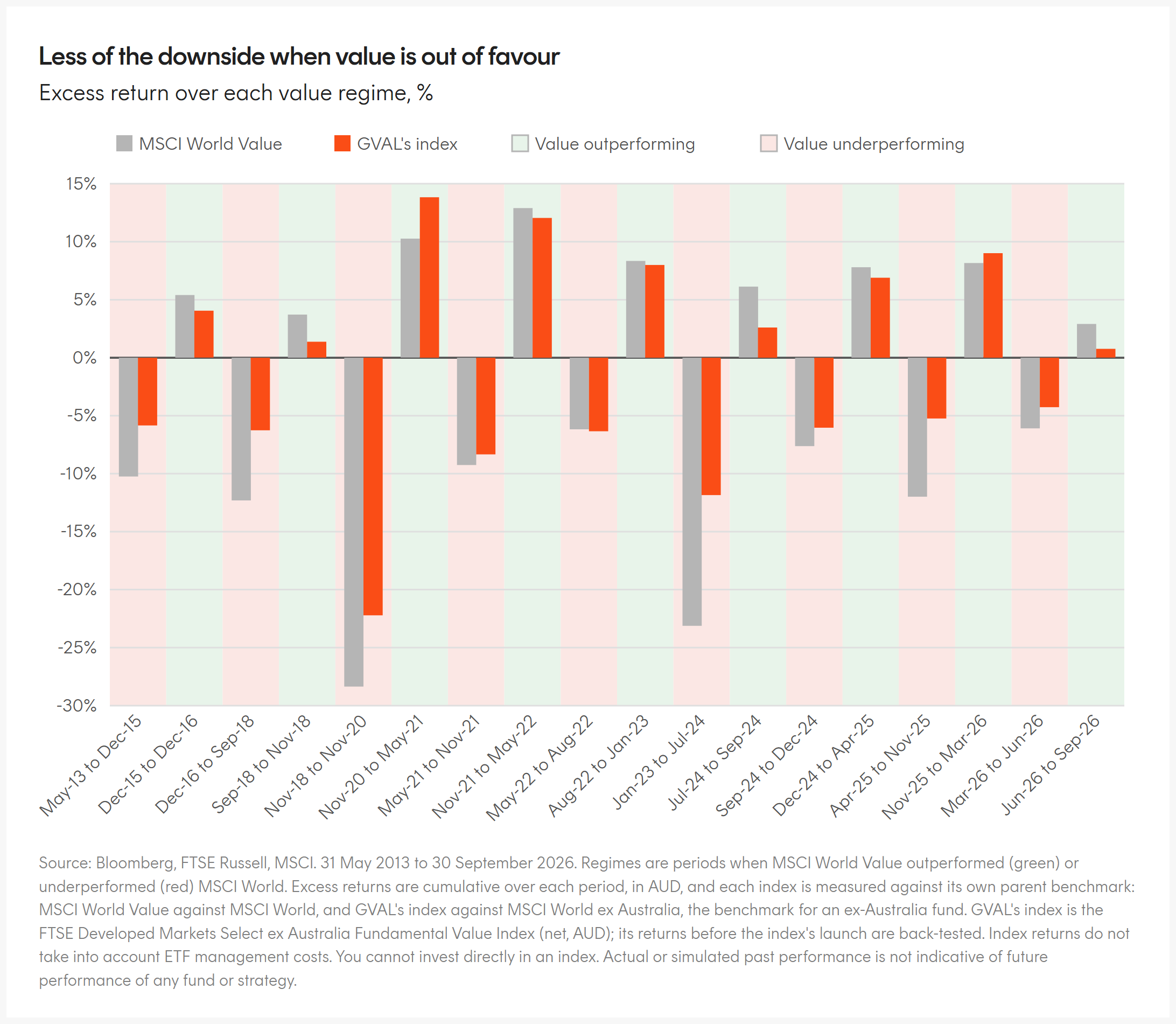
As illustrated below, GVAL’s index has historically captured a substantial share of the upside during periods when traditional value outperformed, while experiencing less severe average declines when traditional value was out of favour. This is due to the approach of holding a broader basket of companies and not just value names in isolation.

Since May 2013, when value outperformed, GVAL’s index captured on average 89% of that upside. More tellingly, when value underperformed, GVAL’s index outperformed traditional value by, on average, 4.3%. In other words, it captured only 66% of the underperformance.2
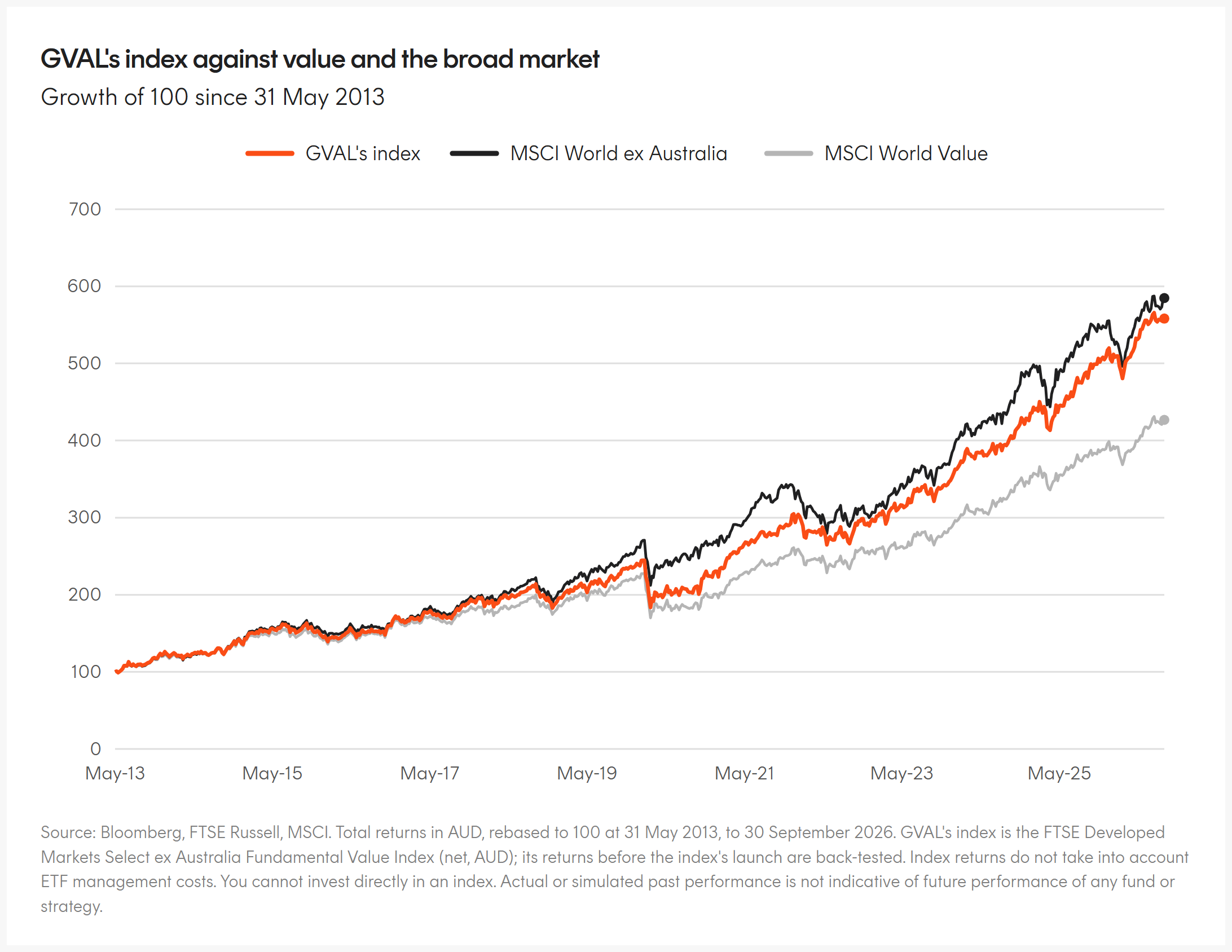
GVAL’s index has trailed MSCI World ex Australia since May 2013, returning 13.8% p.a. against 14.2% p.a., in a period of strong broad market returns led by mega-cap US technology stocks. Over this period GVAL’s index has offered a differentiated source of returns with lower volatility, giving it slightly better risk-adjusted returns.3

Against the traditional MSCI World Value Index, GVAL’s fundamentally weighted index outperformed by 2.3% p.a.4, driven predominantly by its smaller shortfalls when value underperforms.
Investment implications

For investors looking for a solution that focuses on business value rather than market capitalisation, fundamentally weighted indices offer an appealing alternative while also overcoming the shortfalls of some traditional value strategies.

As investors might expect from a value-oriented portfolio, GVAL’s index has a lower valuation than the MSCI World Index, with a P/E of 15.6x against 21.5x, and a higher trailing 12-month dividend yield, 2.3% against 1.5%.5 GVAL can be considered alongside, or in place of part of, a market capitalisation weighted global equity portfolio, or as a targeted value factor allocation within a broader portfolio.

For instance, value, momentum and quality are distinct investment factors with different sources of return. Because they can perform differently across market environments and have historically shown low or negative correlations, combining them may help diversify a portfolio’s sources of return and reduce reliance on any single investment style – as illustrated in our insight here.

With GVAL’s launch, Betashares now offers an ETF for each of the quality, value and momentum factors in both Australian and global markets.

For more information on GVAL visit the fund page here.

There are risks associated with an investment in GVAL and QOZ, including market risk, international investment risk, foreign exchange risk, index methodology risk, security specific risk and sector concentration risk. Investment value can go up and down. An investment in the Funds should only be considered as a part of a broader portfolio, taking into account your client’s particular circumstances, including their tolerance for risk. For more information on risks and other features of the Funds, please see the Product Disclosure Statement and Target Market Determination, both available at www.betashares.com.au.

Prepared by Betashares Capital Limited (ACN 139 566 868, AFSL 341181) (Betashares). The information contained in this article is general information only and does not take into account any person’s financial objectives, situation or needs. Investors should consider the appropriateness of the information taking into account such factors and seek financial advice. This article is provided for information purposes only and is not a recommendation to make any investment or adopt any investment strategy. It may include opinions, views, estimates and other forward-looking statements which are subject to various risks and uncertainties. Actual results or events may differ materially. Any opinions expressed are not necessarily those of Betashares and are subject to change without notice. In preparing this information, Betashares has relied on, without verification, data sourced from external parties. Betashares does not warrant the accuracy or completeness of this information. To the extent permitted by law, Betashares accepts no liability for any loss arising from reliance on the information herein.

1. Source: Bloomberg, FTSE Russell, MSCI. 31 May 2013 to 30 September 2026, total returns in AUD. GVAL’s index is the FTSE Developed Markets Select ex Australia Fundamental Value Index. In each period of value outperformance or underperformance, value’s excess return is the MSCI World Value Index’s cumulative return minus the MSCI World Index’s, and the excess return of GVAL’s index is its cumulative return minus that of the MSCI World ex Australia Index. Upside capture is the average excess return of GVAL’s index across value-outperforming periods divided by value’s average excess return across the same periods. Downside capture is the same ratio across value-underperforming periods. You cannot invest directly in an index. Actual or simulated past performance is not indicative of future performance of any fund or strategy.

2. Source: Bloomberg, FTSE Russell, MSCI. 31 May 2013 to 30 September 2026, total returns in AUD. Capture is the average excess return of GVAL’s index over the MSCI World ex Australia Index as a share of the MSCI World Value Index’s average excess return over the MSCI World Index. GVAL’s index is the FTSE Developed Markets Select ex Australia Fundamental Value Index. You cannot invest directly in an index. Past performance is not indicative of future performance of any fund or strategy. ↑

3. Source: Bloomberg, FTSE Russell, MSCI. 31 May 2013 to 30 September 2026, total returns in AUD. Risk-adjusted returns use the Sharpe ratio, with a 2.0% risk-free rate. GVAL’s index is the FTSE Developed Markets Select ex Australia Fundamental Value Index. You cannot invest directly in an index. Actual or simulated past performance is not indicative of future performance of any fund or strategy. ↑

4. Source: Bloomberg, FTSE Russell, MSCI. 31 May 2013 to 30 September 2026, total returns in AUD. GVAL’s index is the FTSE Developed Markets Select ex Australia Fundamental Value Index. You cannot invest directly in an index. Past performance is not indicative of future performance of any fund or strategy. ↑

5. Source: Bloomberg. As at 30 September 2026. Trailing P/E and trailing 12-month dividend yield. GVAL’s index is the FTSE Developed Markets Select ex Australia Fundamental Value Index. You cannot invest directly in an index. ↑

Written by
Tom Wickenden works as an investment strategist in Betashares investment strategy and research team. Tom is responsible for supporting both the sales and marketing teams across Betashares’ wide range of funds including all major asset classes. In his day-today Tom writes investment insights, prepares and presents investment presentations, attends meetings as a specialist resource, and represents Betashares in external media, podcasts, conferences, and op-eds. Prior to Betashares Tom worked in an accounting firm in London specialising in the fields of audit and forensic accounting. Tom is a Chartered Financial Analyst and has a Bachelor of Commerce majoring in Economics and Accounting from the University of Sydney.
Loading
Feedback
close

This field is for validation purposes and should be left unchanged.
Please rate your experience with our website:*
Please let us know of any recommendations, difficulties or comments you have regarding our website

Feedback