1. Portfolio allocation
- The portfolio has a very attractive yield to worst of 5.9%, with a weighted average credit rating of ‘A’.
- Over the September quarter, HBRD became slightly more defensive, moving into cash, senior bonds and AAA-rated RMBS and reducing spread duration (see below).
- This compares with a new 5-year major bank senior bond yielding 5.5%, a 5-year major bank subordinated bond yielding 6.1%, and a 5-year major bank hybrid yielding 6.4%.
HBRD’s yield currently sits between major bank senior and subordinated debt
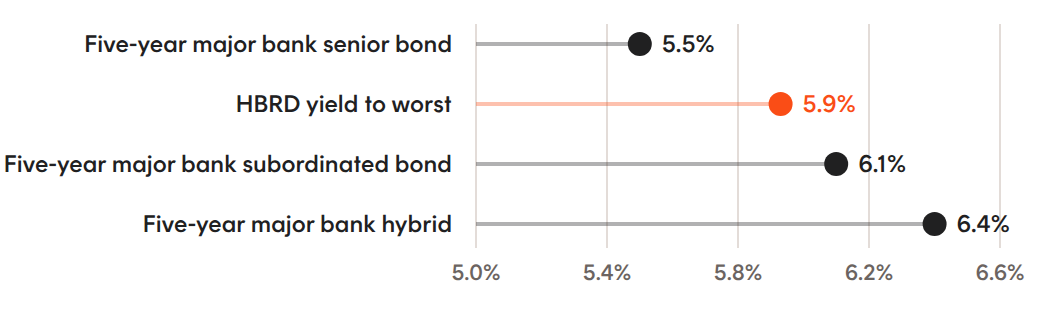
Yield at 30 September 2026, %. HBRD: yield to worst, Betashares. Major bank five-year senior, subordinated and hybrid: running yield of a hypothetical new issue with five years to call or maturity (five-year spread plus three-month BBSW), which at issue equals its yield to worst, Coolabah Capital.
- It has a 19.0% allocation to senior ranking bonds, 7.6% allocation to AAA-rated RMBS, 64.1% allocation to subordinated bonds, and 6.8% to hybrids.
HBRD sector allocation since the mandate was expanded

Month-end allocation, % of portfolio, March to September 2026. Source: Betashares (HBRD fund page).
- HBRD is diversified across 205 securities. It has exposure to 48 different bond and hybrid issuers, which has tripled since the mandate was expanded.
- The fund’s trading activity has increased significantly with the mandate expansion: compared to the same quarter in 2025, the fund participated in more than seven times as many new bond issues.
- Earlier in the year, the fund bought recent new hybrid issues from Suncorp and QBE in the over-the-counter (OTC) market; issuance in the ASX-listed hybrid market has disappeared.
- Over the September quarter, HBRD reduced its allocation to Tier 2 securities and hybrids and moved into cash, senior bonds and AAA-rated RMBS deals. This generally positions HBRD as slightly more defensive, a shift that we thought was warranted due to current credit spread levels and the potential negative catalysts for markets (rate hikes, energy prices and elections). HBRD also reduced spread duration over the quarter, reducing its sensitivity to credit markets.
- This defensive shift provides a lot of optionality and liquidity to the portfolio, giving it the ability to take advantage of any dislocated markets or mispriced assets during periods of volatility. Over the cycle, this active positioning aims to help the portfolio outperform a purely passive exposure to markets (which experiences the round trip of decline and then recovery without taking advantage of it).
2. Why we have added AAA-rated RMBS
HBRD’s AAA RMBS holdings went from nil at the end of March to 7.6% at the end of September. The fund is invested in the senior tranches of prime RMBS issued by Australian banks. Over the September quarter we added two new positions: ANZ’s Kingfisher 2026-2 (BBSW+92bp) and Bendigo Bank’s Torrens 2026-1 (BBSW+94bp). We also took profits on AAA-rated RMBS positions that had significantly rallied.
The sector remains attractive for a few reasons:
- Relative value and yield. New AAA RMBS has priced at BBSW+92 to 94bp through 2026. Over the same period, 5-year major bank senior bonds tightened to about BBSW+65bp. That makes the AAA pick-up about 27 to 29bp, compared with 10 to 18bp in late 2025 (see chart below). This boosts the yield of HBRD.
- AAA rating. These are the most senior tranches, backed by prime Australian residential mortgages and protected by subordination beneath them. They sit above major bank senior debt (AA- for Australian major banks) in the rating scale.
- Liquidity. The AUD RMBS market has a deep bank and real-money investor base. AAA RMBS are also RBA repo-eligible, which significantly improves liquidity.

3. Trading activity: a more active, more diversified portfolio
The wider mandate introduced at the end of March 2026 has enhanced the opportunity set for HBRD. Compared with the same quarter last year:
- HBRD made about 50% more bond trades.
- It now has 205 different securities across different issuers, currencies and bond types, far more than concentrated single-sector competitors.
- It traded across twice as many securities.
- It traded across four currencies (AUD, EUR, USD, GBP) as opposed to just AUD.
- It invested in more than seven times as many new bond issues.
HBRD trading activity against a year earlier

September quarter 2026 as a multiple of the September quarter 2025. Source: Coolabah Capital.
New bond issues matter for HBRD because they usually come with a concession to where the issuer’s existing bonds trade. Coolabah uses its 80+ quantitative fair value models to identify the size of any mispricing and selects which bonds to buy. When the bond trades toward its fair value, it gains in price, providing capital appreciation for the fund. The chart below shows the realisation of gains/losses on $641m of primary trades across 2026: a win rate of 92.5% across 650 trades.
Fund sell trades: total return on each 2026 sale

Total return on each 2026 sale of a bond bought in a new issue, %, January to October 2026. Overlapping sales near 0% sit behind one another. Source: Coolabah Capital.

Sales during 2026 of bonds bought in new issues, to October 2026. Source: Coolabah Capital.
4. Hybrids: the opportunity has moved to the OTC market
With APRA phasing out bank AT1 capital, new ASX-listed hybrid supply has evaporated. The better hybrid opportunities are increasingly in wholesale OTC issues from regulated financials. This year, HBRD bought:
- Suncorp Group AT1 (BBSW+235bp, priced 29 April 2026)
- QBE Insurance Group capital notes (BBSW+250bp, priced 12 May 2026)
The fund has largely avoided corporate hybrids, where we think the structural subordination, the issuer’s ability to defer coupons and the weaker credit quality are not paid for at current prices. All of HBRD’s hybrid exposure is with APRA-regulated banks and insurers (e.g. CBA, ANZ, NAB, Westpac, Suncorp).
5. Performance over the September quarter
Through the quarter, HBRD was conservatively positioned in high-quality names and higher-ranking securities to protect against wider credit spreads, particularly among riskier issuers such as the French banks, whose Tier 2 spreads widened the most over the quarter.
Over the quarter, HBRD returned 1.09% after fees, compared with 1.61% for its benchmark.
| Return after fees | 3 months | 1 year | 3 years p.a. | 5 years p.a. | Since 31 Mar 2026 |
|---|---|---|---|---|---|
| HBRD | 1.09% | 4.59% | 5.58% | 4.51% | 2.65% |
| Benchmark (RBA cash rate + 2% p.a.) | 1.61% | – | – | – | 3.21% |
Returns to 30 September 2026, after fees, based on NAV with distributions reinvested. Effective 31 March 2026, HBRD changed its strategy and its benchmark to the RBA cash rate + 2% p.a.; returns for periods before that date reflect the prior strategy, benchmarked to the Solactive Australian Hybrid Securities Index. Source: Betashares. Past performance is not indicative of future performance.