



Global week in review: soft news is good news
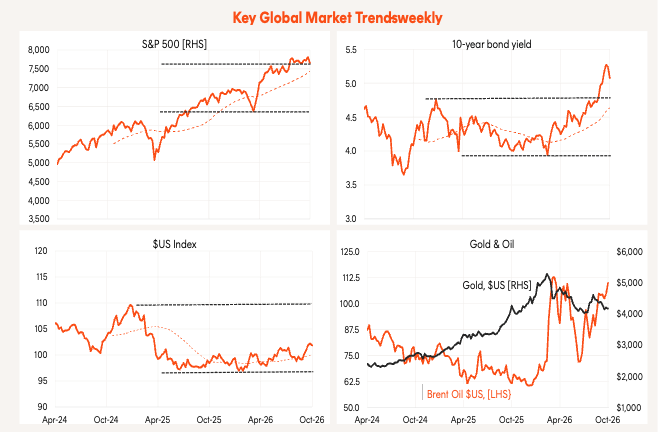
Global stocks sold off last week, reflecting renewed jitters with the AI trade.

Source: Betashares, Bloomberg.
The corrective nature of markets was evident again last week with rising bond yields helping generate a pullback in global technology stocks. The tech sell-off, however, then led to safe-haven flows into the bond market, sending bond yields lower.
There are several drivers of the tech sell-off. From a macro perspective, the slightly hotter-than-expected US core CPI result last week sent bond yields higher, with traders initially increasing the risk of a Fed rate hike at next week’s policy meeting. The headline CPI rose 0.6% in September, as expected, taking the annual rate to 3.7% from 3.4%. The bigger disappointment was core: a 0.3% gain rather than the hoped-for 0.2%, lifting the annual rate to 2.6% from 2.4%. The gain in core prices reflected firm shelter and core goods prices.
Ongoing oil disruptions, renewed attacks in the Middle East and the failure of an “energy ceasefire” between Russia and Ukraine also saw Brent crude oil futures rise 4.9% last week to $US109.9 a barrel. This only adds to investor inflation and interest rate fears.
At the tech coal face, there are also building concerns around the massive debt build-up, especially among cloud providers such as CoreWeave. Unlike the hyperscalers, these smaller players don’t have much in the way of legacy businesses to fall back on if the AI boom implodes.
Last but not least, there’s concern around growing competition in various parts of the AI ecosystem, from computer chips to language models. Even if AI demand booms, greater competition could still make it hard for companies to generate profits.
The US earnings reporting season has also started on shaky foundations, with mixed results from the major banks last week. Only Goldman Sachs and Citigroup reported market-pleasing results, but even their shares struggled to post strong gains.
All that said, the market ended last week attaching only a 15% chance to a Fed rate hike at next week’s meeting, favouring a December rate hike instead (90% chance).
Global week ahead: US CPI
This week is quiet on the data front, with the focus likely to be on US earnings reports. This week’s focus is tech, with Meta, Tesla, Netflix and SpaceX among the major companies reporting. After last week’s turbulence in tech stocks, guidance on AI spending and margins will be a focus.
On the data front, Friday’s S&P Global flash PMIs are the main release. Note that stronger-than-expected PMI results for the US led to a bond market sell-off last month.
Global equity trends: Tech reversal
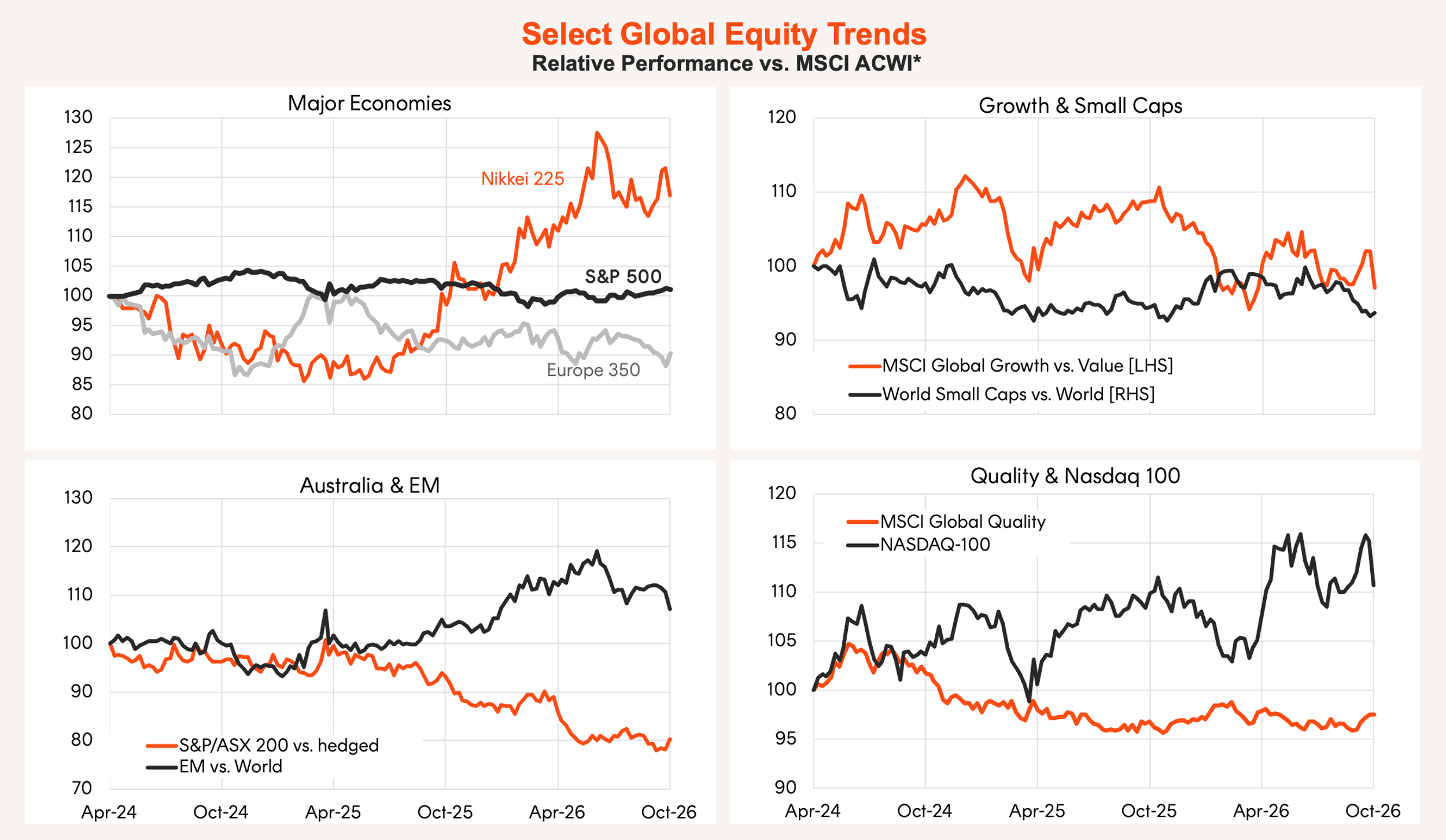
After a rebound in relative performance over recent months, popular AI trades gave back a good chunk of their outperformance last week. The Nasdaq 100 fell 5.5%, while the global momentum factor dropped 7.9%. Japan and emerging markets also suffered relatively heavy declines given their now heavy tech exposure. Value-oriented exposures such as financials and materials fared better.
Interestingly, despite AI jitters, the overall global technology sector managed a modest 1.3% gain – so some tech companies, less exposed to the blue-sky AI trade, still managed to perform OK.
*All but value factors. Local currency basis. Source: Betashares, Bloomberg.
Australia week in review: weak sentiment
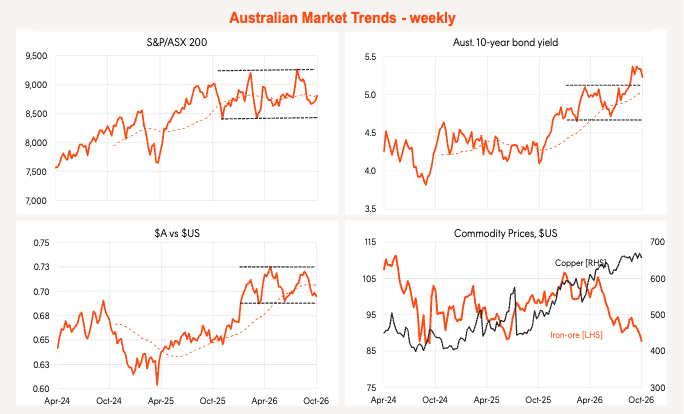
The local equity market did a “Steve Bradbury” last week, holding up against the global sell-off – helped by its low exposure to the AI trade.

Source: Betashares, Bloomberg.
That’s despite the fact local economic news was far from upbeat.
Minutes from the latest RBA meeting, at which rates were increased, were unsurprisingly hawkish. The minutes show the Board did briefly consider leaving rates steady, given greater-than-expected house price declines, but concluded there was enough evidence of simmering inflation pressure to justify a hike ahead of the all-important Q3 CPI result next week.
The question is whether the September rate hike brought-forward an increase the RBA had been considering for November given the RBA did not want to wait that long or if it still leaves the risk of another hike in November if next week’s Q3 CPI result is hot.
As it stands, the RBA’s August forecasts imply quarterly trimmed mean gains of 0.8% in both the September and December quarters. That suggests a 0.8% gain – in line with expectations, could be enough to keep the RBA on hold, especially given the pre-emptive September hike. As it stands, the market currently attaches only a 15% chance of a rate hike in November.
Adding to the case to leave rates on hold, last week delivered further evidence of economic slowing. In the NAB business survey, the confidence index took another beating, falling 4 points to -13. That’s a third straight monthly fall, and it puts confidence well below its long-run average. Conditions, perhaps surprisingly, held at -1, but the employment index slid to a five-year low.
Thursday’s jobs report was also soft. Employment fell by 39,300 – against expectations of a gain of around 20,000. The unemployment rate came in at 4.7%, a post-COVID high and a notch above the 4.6% expected (August was revised up to 4.7%). For the RBA, that’s a welcome cooling – though given recent employment volatility, it’s likely taking the result with a grain of salt. In last week’s minutes, it was noted that “considerable caution is warranted when interpreting the current official labour force data, because of methodological changes to the survey.”
Local equity market trends: Defensives favoured
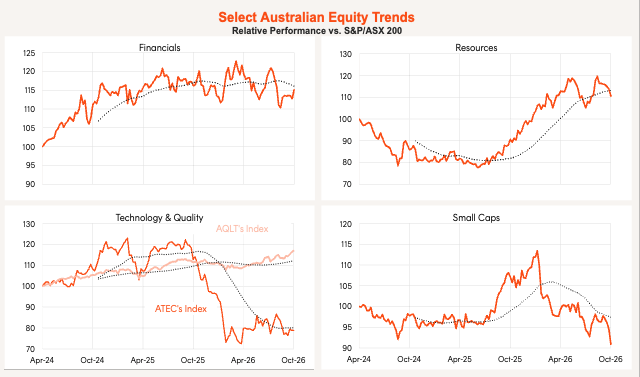
It was a mixed picture across sectors last week, with only materials, property and technology in the red. Utilities, health care and consumer staples did best.
In terms of major sector trends, the resource sector’s recent outperformance has been challenged by higher global interest rates and the risk to global growth that this entails. That’s seen a bounce-back in the relative performance of financials. Small caps remain in the doldrums, while the quality factor continues to steadily outperform.
Source: Betashares, Bloomberg.
Australia week ahead: Labour market report
Locally, it’s slim pickings on the data front this week. The big news comes the week after, with the September quarter CPI and the FOMC decision both on Wednesday 28 October.
What we have is more RBA rhetoric, with “fireside chats” scheduled for Assistant Governor Kent this morning and Deputy Governor Hauser tomorrow. Of interest will be whether the recent weakening in local economic data has softened the hawkish rhetoric of late.
Have a great week!
