

Ned Stewart
7 minutes reading time


‘Strike while the iron is hot’. ‘Rome wasn’t built in a day’. ‘Make hay while the sun shines’. We grow up absorbing these sayings without ever really questioning them. They sound wise, they feel intuitive, and we pass them on without a second thought.
But here’s the thing about conventional wisdom: it isn’t always right.
Investing has its own set of deeply embedded sayings that millions of people accept as gospel. And just like the ones above, they sound logical on the surface. The problem is that, for everyday investors, acting on them can potentially do more harm than good.
Here are three of the most common investing myths, and what the evidence says.
1. Buy low, sell high
Arguably the most well-known phrase in the investing universe and intuitively it makes complete sense. We’re all in this investing game for one simple thing: to make more money in the future than we have today. So of course we want to buy something when it’s cheap and sell it to someone else when it’s expensive.
But while it may make intuitive sense, ‘Buy low, sell high’ is unfortunately a lot easier said than done.
It’s been proven time and time again that, for the everyday investor, consistently buying at the bottom and selling at the top is close to impossible. And this isn’t just a trap that catches new investors. Many professional investors spend their entire careers attempting to time the market and still fall short.
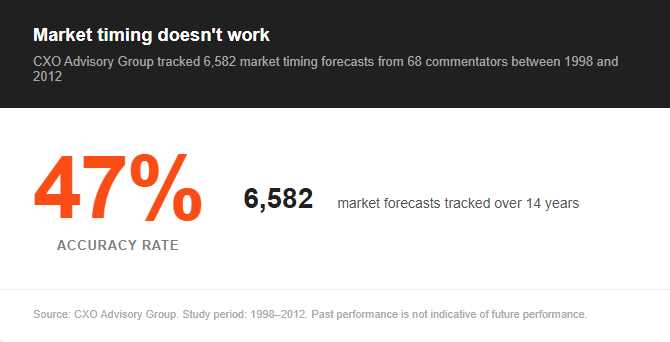
We can see this in a study by CXO Advisory Group. Between 1998 and 2012 they tracked 6,582 forecasts from 68 industry experts. And their findings? Their cumulative accuracy didn’t even reach pass mark: only 47% of the market forecasts were correct and not a single ‘guru’ exceeded 68% accuracy.
So I will counter ‘Buy low, sell high’ with another common investing adage: ‘Time in the market beats timing the market’.
A Bank of America study looked at the S&P 500 from 1930 to 2021 and the implications of if a person missed the best 10 days in the market of each decade.
Based on this study, if you had invested in 1930 and then done nothing, just kept your money in the market, you would have achieved a total return of 17,715%. 1
If on the other hand you had tried to time the market, and by some misfortune ended up missing out on the 10 best days in each decade, you would after 91 years have been left with only a 28% return. 1
2. You need lots of money to start investing
‘Investing is only reserved for the uber wealthy’. Those who summer in the south of France or spend their winters in the Swiss Alps.
Growing up, this wasn’t so much a myth as it was a reasonable assumption. Investing in the 1980s and 1990s genuinely did require a large lump sum of money and an in-person meeting with a stockbroker to execute a trade.
The myth persists. HSBC’s annual Australian investor research for 2023 found that on average Australians still believe they need $15,200 to start investing. That’s up from the previous year which was $14,800.
But the reality is that anyone can now invest with the change in their pocket.
Platforms have slashed the barrier to entry, with many now offering $0 brokerage fees. And while spare change may not sound like much, investing just $1 a day for 50 years, growing at the ASX’s historical average annual return of 11%2 including dividends, could grow to close to $800,000.3
3. Investing is too risky right now
There is plenty of reason to be worried about the state of the world right now. Wars rage on across the globe, shipping routes have been disrupted, driving up the price of everyday goods, and companies appear to be announcing AI-related job cuts on a daily basis. It is completely understandable to feel hesitant about investing when the outlook for the future feels this uncertain.
But economic uncertainty and market crashes are simply the price of admission for long-term investors.
When geopolitical events dominate the headlines, the natural instinct is to panic. War, conflict and political crisis can be the moments when investors convince themselves the market is about to collapse and make emotional decisions they later regret.
But history tells a very different story.
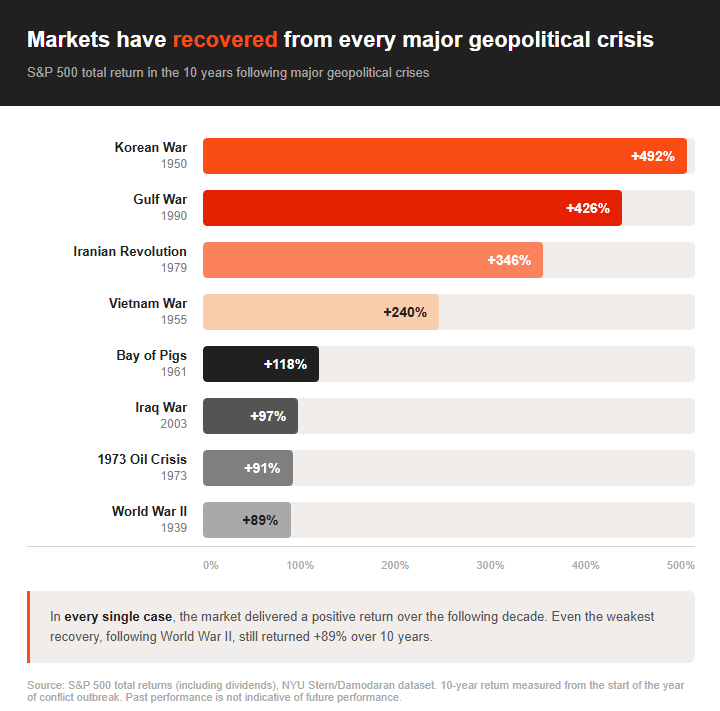
Looking at six of the most significant geopolitical events of the last century – World War II, the Bay of Pigs, Korea, Vietnam, Iraq and the Gulf War – the stock market didn’t just survive. It rebounded. In every case, the S&P 500 delivered a strongly positive return within 10 years of the event. The worst performer of the six was World War II, where the market was still up 89% a decade on. The best performer was the Korean War, after which the market climbed 492% over the same period.
Not every recovery was quick. The 1973 oil crisis and the 1979 Iranian Revolution both triggered painful downturns and, in the case of 1973, it took years for the market to return to its previous level. But even these, the most damaging geopolitical shocks of the last century, were eventually overcome by patient investors who stayed the course.
You cannot invest directly in an index. Past performance is not indicative of future performance.
If the uncertainty still feels uncomfortable, one practical approach is dollar cost averaging – investing a fixed amount at regular intervals regardless of what markets are doing. Most Australians already do this through their super without realising it.
Betashares Direct’s Auto-invest feature makes it simple to apply the same approach to your personal investments, with recurring investments into up to five Betashares ETFs, brokerage-free.4
The takeaway is simple: the natural inclination is to panic and sell during times like this. But what the data consistently shows is that the stock market is remarkably resilient. It may wobble in the short term but, given time, it keeps grinding higher.
The information is general in nature only and does not take into account any person’s financial objectives, situation or needs. Investors should consider its appropriateness taking into account such factors and seek financial advice. It is not a recommendation to make any investment decision or adopt any investment strategy.
Any information provided is not a recommendation or offer to make any investment or to adopt any particular investment strategy. Investors should make their own professional assessment of the suitability of such information, relying on their own inquiries.
Future results are impossible to predict/inherently uncertain. This article may include opinions, views, estimates, projections, assumptions and other forward-looking statements which are, by their very nature, subject to various risks and uncertainties. Actual events or results may differ materially, positively or negatively, from those reflected or contemplated in such forward-looking statements. Forward-looking statements are based on certain assumptions which may not be correct. You should therefore not place undue reliance on such statements. Betashares does not undertake any obligation to update forward-looking statements to reflect events or circumstances after the date such statements are made or to reflect the occurrence of unanticipated events.
Footnotes1. This is a hypothetical example only from a study conducted by a third-party. It is provided for illustrative purposes only and does not constitute financial advice. It does not account for an individual investor’s tax position, fees or economic factors such as inflation. Past performance is not indicative of future performance. This is not a recommendation to adopt any particular investment strategy. ↑2. Source: S&P/ASX 200 (XJO)
3. Hypothetical illustration only. Assumes $1/day ($30.42/month) contributed consistently over 50 years, compounded monthly at 11% p.a. (based on the long-run historical average total return of the S&P/ASX 200, including dividends reinvested). Returns are nominal and have not been adjusted for inflation, fees, taxes, or transaction costs. Past performance is not a reliable indicator of future performance. This is general information only and not financial advice.
4. Refer to the PDS for information on interest retained by Betashares on cash balances. ↑
1 comment on this
I disagree about time in the market versus timing the market. In 2008 I was buy and hold and saw my portfolio drop by 60% from around $300,000 to just over $100,000. It took 10 year to recover. As a result I joined the ATAA (Australian Technical Analysts Association) and learned to read charts and entry and exit points. I found out that most of the members of the ATAA had sold early in January 2008 with a loss of 15-20% and went 100% into cash they then had a bucket load of money to buy back into the mkt in March/April 2009. Now in my 80’s I can’t afford to sit through another GFC crash so I have exit positions on all my stocks and ETFs. My Betashares holdings of mainly Asia, Global, US, Emerging and resources is actually beating the XJO accumulation index which I use as a benchmark. Very late in life, I have realised that ETFs are much better than individual stocks – you might miss some rocketing stocks such as Seagate (STX) and Western Digital (WDC) up > 1000% in 1 year but you might pick one doing the opposite.