



Key points
Despite geopolitical headwinds this year, investors remain focused on the artificial intelligence (AI) theme this earnings season as the US megacap hyperscalers1 continue to drive S&P 500 returns and earnings growth over recent quarters.
However, their success has also meant their collective weights dominate global share market indices. While concentration is not necessarily a bad thing, investors seeking to diversify beyond the relentless momentum that AI-related investments have enjoyed could consider other exposures.
How did we get here?
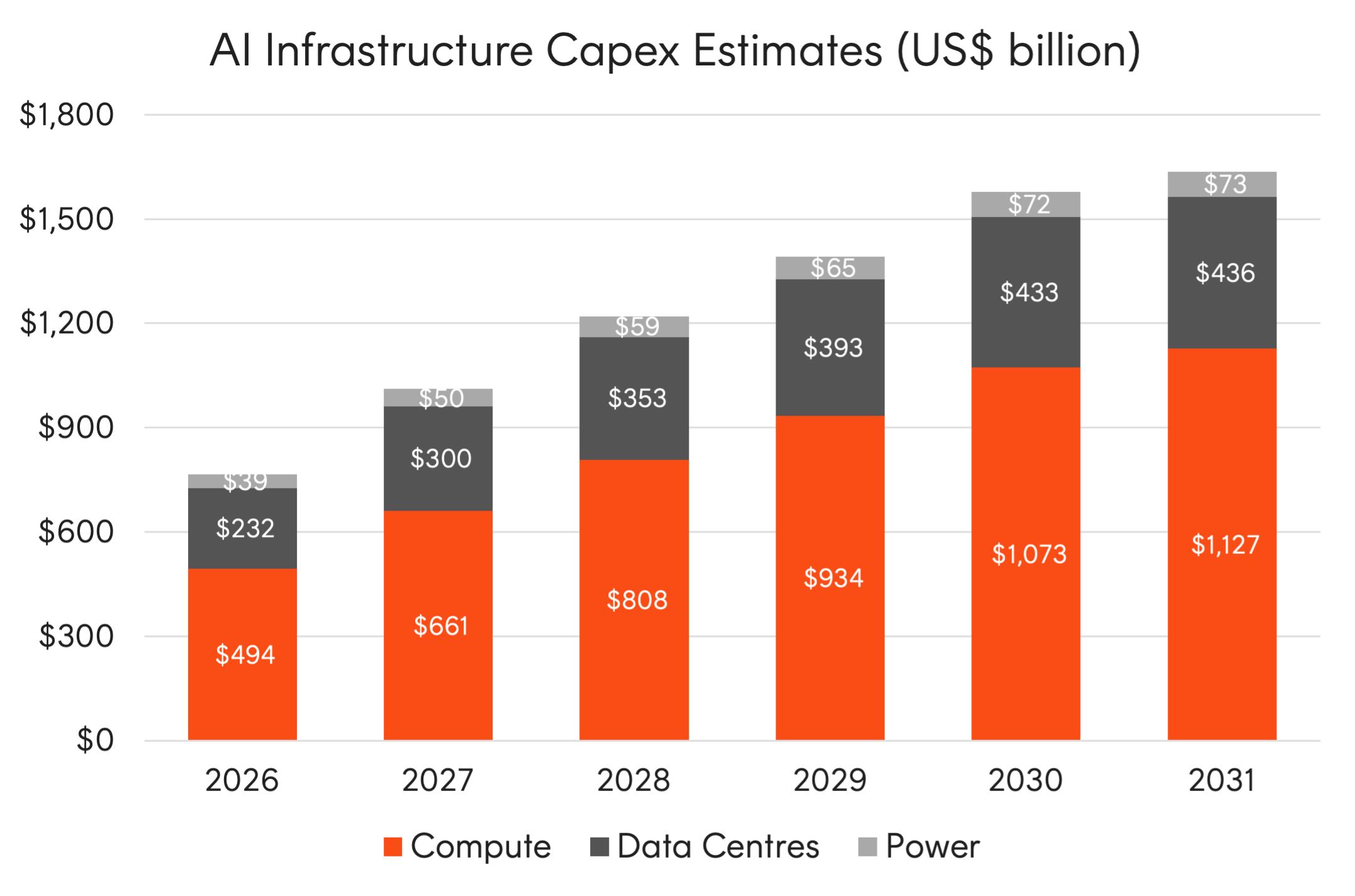
A key metric that investors have been paying attention to is the amount of capital expenditure, or capex (the money a company spends on long-term physical assets), that many of the US large-cap tech companies are spending on data centres to build out compute capacity in response to the insatiable demand for cloud computing, AI training and inference workloads.
Collectively they are forecast to spend US$700 billion this year, which has driven a reacceleration in cloud computing2 earnings growth and increased conversion in digital ad-targeting engines.
Source: Goldman Sachs Global Institute.
That momentum is likely to continue with the S&P 500 Information Technology sector expected to grow earnings by 63.3%3; however, the benefits are broadening beyond the hyperscalers to other companies further up the AI supply chain including semiconductor equipment manufacturers and memory chip providers like Micron.
Asian equity markets have also enjoyed positive windfalls from the US-led capex build out. South Korea’s KOSPI index is the best-performing market year to date4 as local chip makers Samsung and SK Hynix have benefited from the structural bottleneck for dynamic random-access memory (DRAM) and high bandwidth memory (HBM) chips.
In Taiwan, TSMC (Taiwan Semiconductor Manufacturing Company) remains integral to the AI supply chain given its role as the world’s leading advanced chip foundry. However, the local stock exchange is home to other leading semiconductor companies like MediaTek and ASE Technology5 which are also experiencing strong earnings growth from AI-driven demand.
The rising influence of AI on equity markets
The impact of AI and its influence on equity markets is hard to ignore. But the clear risk is that investors’ broad equity exposures are quietly becoming exposed to a narrow group of megacap technology companies; the Magnificent 7 tech stocks account for 23%6 of the MSCI World Index for example.
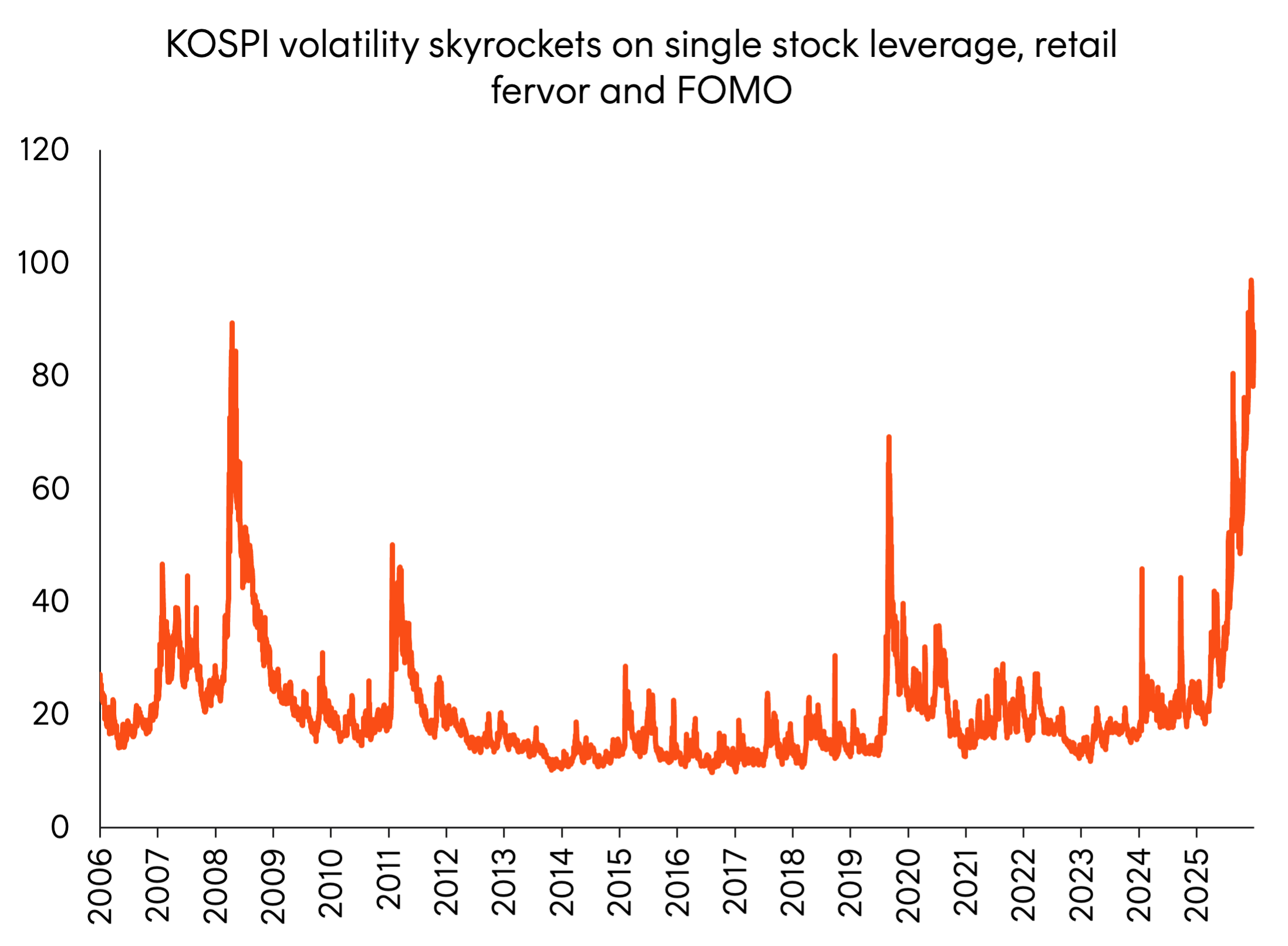
Similarly, South Korea’s rally this year is especially concentrated in just two names, Samsung Electronics and SK Hynix, which together account for a little over half of the index after entering the US$1 trillion market-cap territory earlier this year. Additionally, the approval of leveraged single-stock ETFs by South Korean regulators in May has led to index-level volatility of the KOSPI rising sharply.
Source: Bloomberg. As at 15 July 2026.
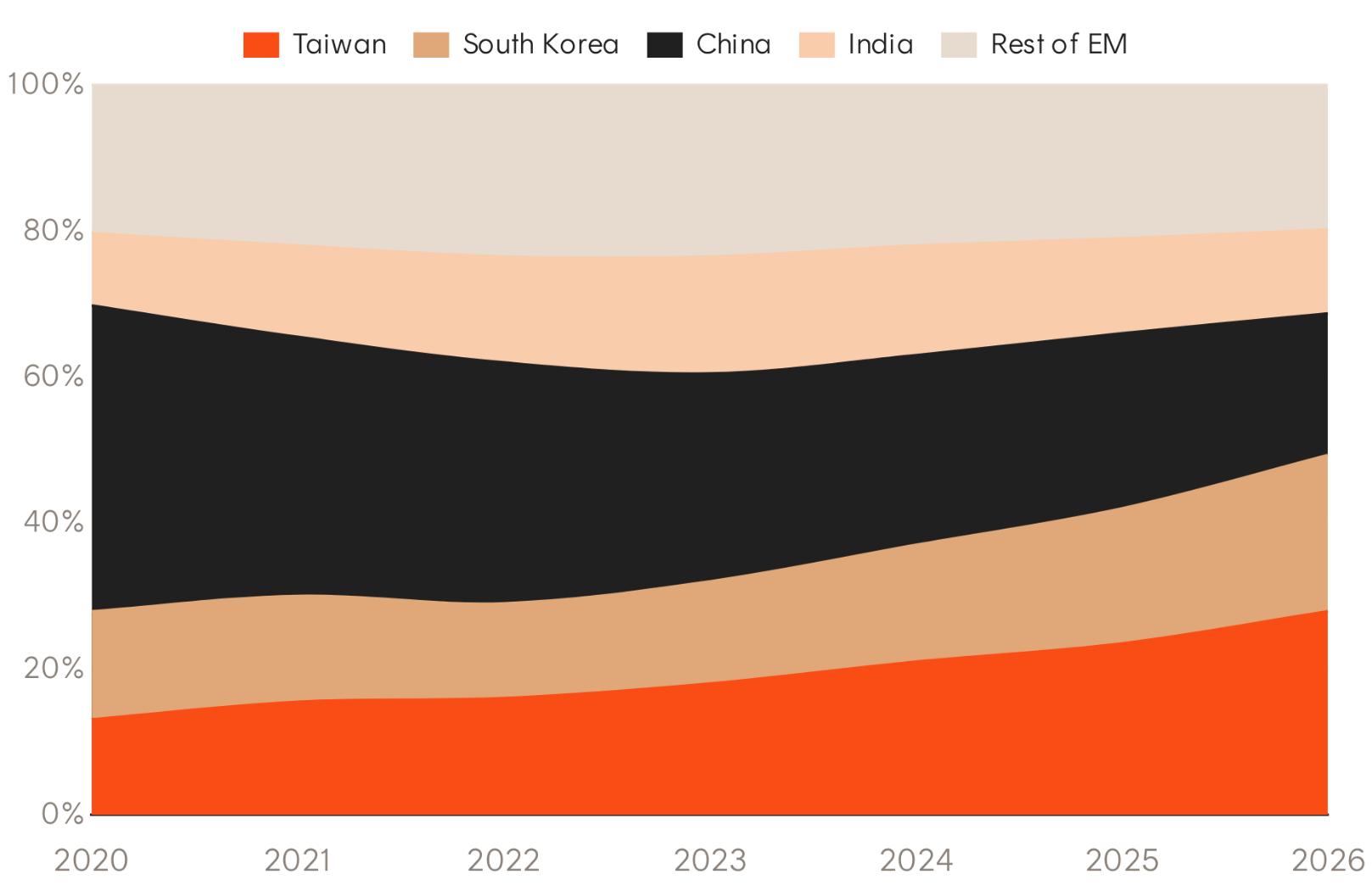
South Korea’s weight in the MSCI Emerging Markets Index, alongside Taiwan, has risen considerably since 2020 as shown in the chart below. The leading companies7 within these markets account for 30% of this index as at 30 June 2026.
Source: iShares (MSCI EM / EEM), Bloomberg, Betashares. Country weights 2020 to 2025 derived from fund market values, latest as at 2 July 2026.
Given the multi-year AI-led rally thus far, high levels of concentration will likely heighten the sensitivity of more technology-exposed market indices. Given how hard some of these stocks have run, any revenue miss could lead to a pronounced sell-off across the broader AI supply chain.
Other risks that could potentially derail momentum in the AI theme include enterprises scaling back on token usage should CFOs remain cost-conscious, downward revisions to hyperscaler capex spending, or the highly anticipated IPO listings from Anthropic and OpenAI injecting a wave of equity issuance. More recently, the release of Kimi K3 (an open-source Chinese AI model rivalling the performance of Fable 5 and GPT-5.6) has triggered an unwinding of momentum in semiconductor related exposures.
Investment implications: staying invested, but reducing concentration risk
Still, the structural case for AI remains intact. Enterprise adoption rates are rising, HBM capacity is effectively sold out throughout 2027, and hyperscaler capex is still being revised up. However, index-level exposures, whether through the S&P 500 or developed Asian markets like South Korea or Taiwan, have become much more concentrated.
Investors seeking other exposures to diversify or reduce their AI-related holdings may consider the following as options:
Betashares S&P 500 Equal Weight ETF (ASX: QUS)
Through its equal-weighted methodology, QUS S&P 500 Equal Weight ETF reduces concentration in tech-related names that have a dominant weighting in the S&P 500 while having higher exposure to sectors such as industrials, financials and consumer discretionary. The strategy may be well positioned if US earnings growth broadens beyond the largest technology companies, market concentration unwinds or more cyclical sectors regain market leadership, conditions that have historically favoured more diversified approaches.
QUS S&P 500 Equal Weight ETF can also be complemented by a traditional market-cap-weighted NDQ Nasdaq 100 ETF allocation, providing broader participation in the US equity market while reducing reliance on a small group of companies continuing to drive returns.
Betashares Global Shares Ex US ETF (ASX: EXUS)
EXUS Global Shares Ex US ETF provides a global developed markets exposure that excludes the US and Australia. This exposure provides both geographic and sector diversification benefits to more US-heavy portfolios. EXUS Global Shares Ex US ETF has a higher weighting to sectors such as financials and industrials, and a lower weighting to technology (~25% less than the S&P 5008).
Betashares India Quality ETF (ASX: IIND)
One Asian market that offers differentiated exposure from the AI-led market cycle is India. Whilst it has faced headwinds from the Middle East conflict, rupee weakness and foreign institutional investor selling, India’s structural growth outlook remains intact with Goldman Sachs forecasting real GDP growth of 6.9% in 2026 and 6.8% in 2027.