

David Bassanese
6 minutes reading time


If you’d prefer to listen to this week’s edition in podcast form, please click the player below:
Global week in review: inching to a deal
The global picture this week looks much like last week’s, with my sentiment still applying: “US equities continued their move into record territory last week, with on-again off-again reports of an imminent US-Iran peace deal. At the time of writing late Monday morning, reports suggest both sides were still inching towards a deal.”
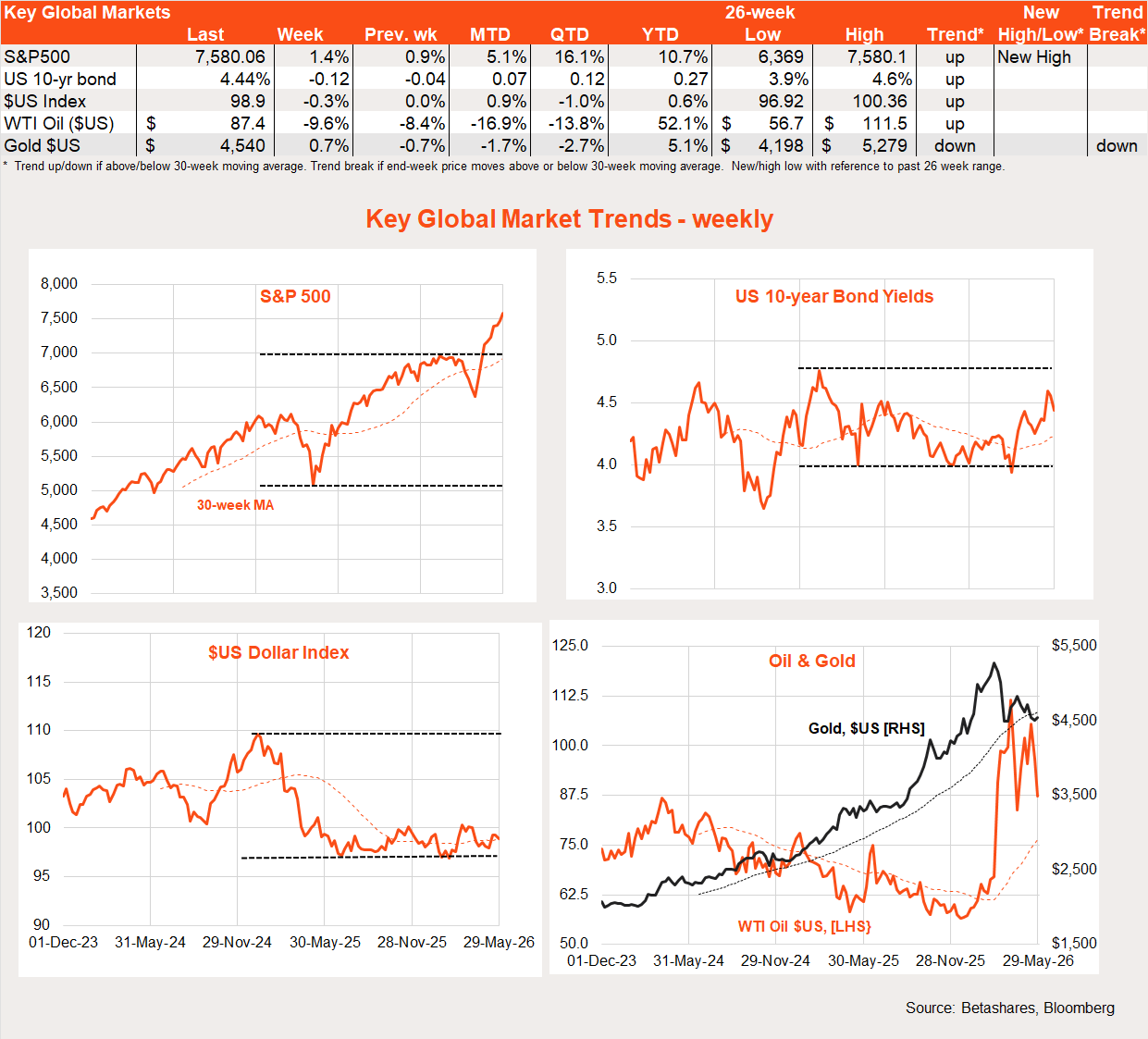
Ongoing peace talk hopes continued to support equities last week, helped by a 10% drop in oil futures. Easing oil prices and associated easing inflation fears also saw US 10-year bond yields retreat 0.12% to 4.44%, after a steep sell-off a few weeks ago. The US dollar remained steady, however, trapped in a narrow range. The stabilisation of the US dollar over recent months – following its decline in H1’25 – has removed one tailwind for gold prices, which remain broadly in retreat despite growing optimism around a US-Iran peace deal.
The key US economic report last week was the consumption deflator measure of inflation. At face value, the numbers were not great, with headline prices up 0.4% in the month and 3.8% over the year. Yet this gain, along with a 0.2% gain in core prices (excluding food and energy), were both a touch softer than market expectations.
As regards Iran, it seems clear Trump wants to sign a deal and move on from this ill-fated adventure soon. But Iran, thanks to its ongoing control of the Strait of Hormuz, seems to be driving a hard bargain. Trump is under pressure not to strike a deal which is not much better (and maybe worse) than the Obama agreement he tore up a few years ago. By all reports though, the clock is ticking as global oil inventory buffers dwindle by the day.
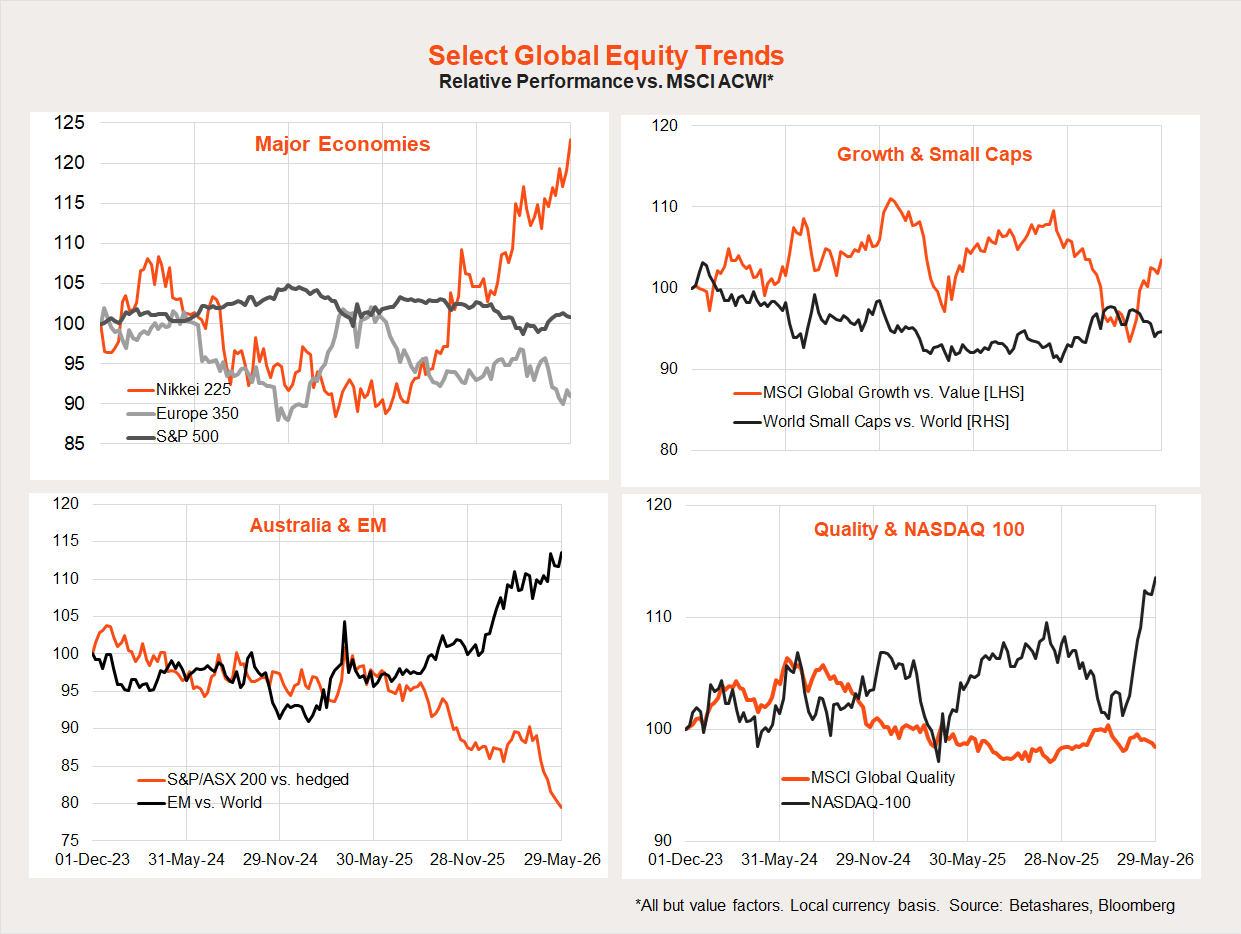
The other big story globally remains the AI boom. Technology was the standout global sector last week with a 5.2% gain. Japan is also on fire, helped by its exposure to several leading companies in the global computer chip market.
Global week ahead: Iran and payrolls
As has been the case for several months, the market’s focus will remain on progress in US-Iran peace talks.
There’s also a smattering of US economic data, including job openings and ISM reports on manufacturing and services. But the biggest report will be payrolls on Friday, with a moderate 95k gain in jobs expected which should keep the unemployment rate steady at 4.3%.
Global equity trends: AI trade in full force
Technology, Japan and emerging markets were among the biggest winners last week, with energy down due to lower oil prices. The underperforming S&P/ASX 200 eked out a 0.9% gain.
All up, the Nasdaq-100, Japan and emerging markets continue to do best in the rebound so far, whereas Europe, Australia and small caps have not. The Nasdaq-100 has continued to shoot the lights out.
Australia review: CPI relief
Local stocks rode the coattails of global optimism again last week, and were also helped by a slightly softer-than-expected April CPI inflation report.
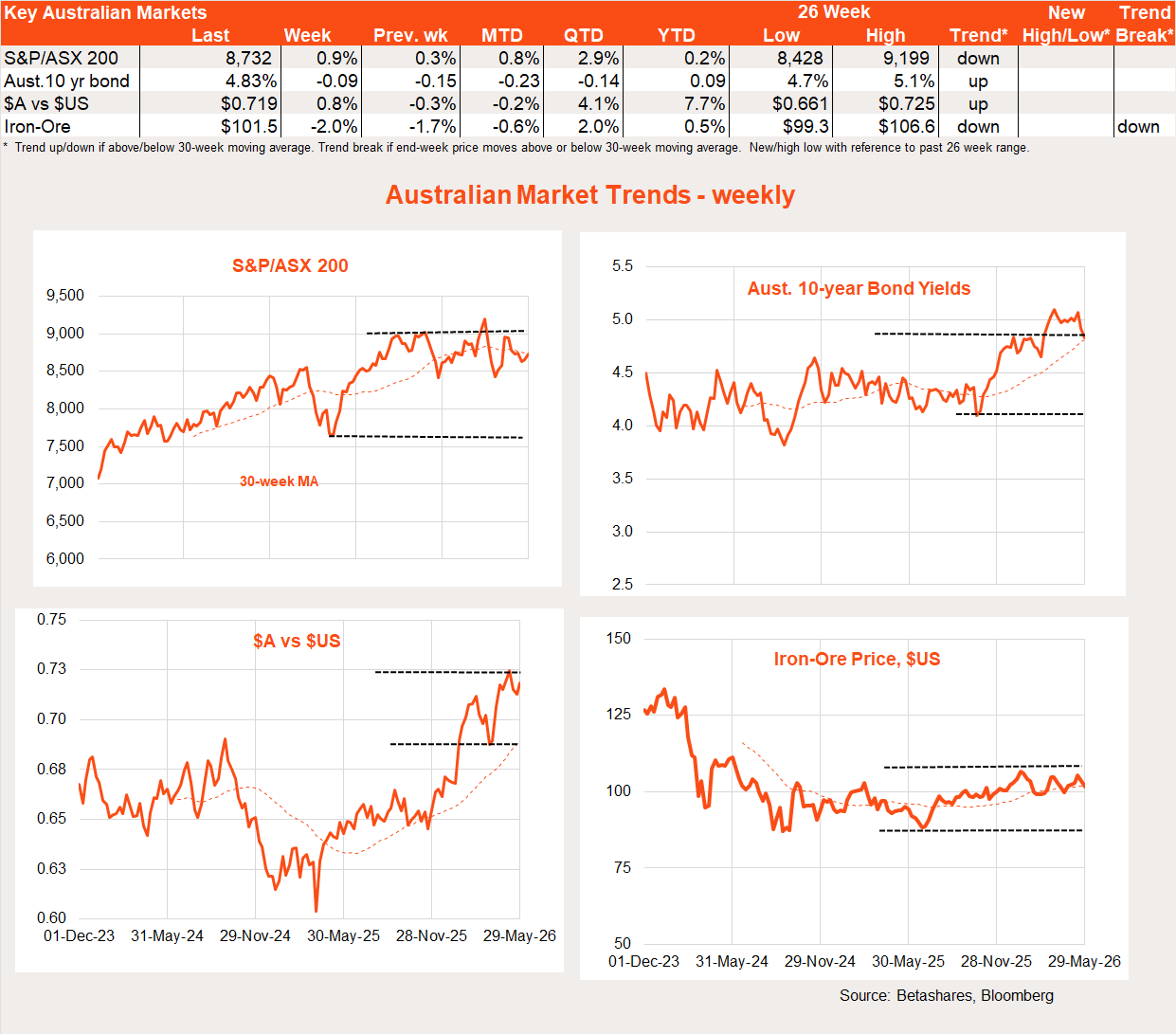
As was the case in the US, local inflation news last week was not great at face value – though at least not worse than the market feared. Headline consumer prices rose 0.4% in April (market +0.5%), which allowed annual inflation to ease to 4.2% from 4.6%. The trimmed mean inflation measure rose 0.3%, in line with market expectations, which pushed annual underlying inflation to 3.4% from 3.3%. Anecdotal reports suggest energy-related 2nd-round cost pressures are building across the economy – the end of the Iran war can’t come soon enough!
The early reports on Q1 economic activity were mixed. Construction spending rose a solid 3.4%, with very strong growth in data centre investments – and a lumpy surge in mining investment – partly offset by weakness in housing construction and public infrastructure. Private capital spending was also solid in the quarter, underpinned by Australia’s own data centre boom. Although a good chunk of data centre investments are imported, it’s still a source of demand pressure at a time of a still capacity-constrained economy.
In other news, the fallout from the Federal Budget continued, with the Albanese Government resisting growing calls around the business community to limit changes to capital gains tax to only residential property. Small carve-outs for technology start-ups and very small companies won’t cut it.
I’m personally still gobsmacked both the Treasury and an Australian Treasurer would want to nearly double the capital gains tax on high growth investments from 25% to a world-beating 47% – and then still claim it will have limited economic effect. It has dented my faith in both!
Auction clearance rates in Sydney and Melbourne hovered just above the 50% mark last weekend, consistent with continued declines in nominal house prices.
Local equity market trends: Technology/small caps bottoming out?
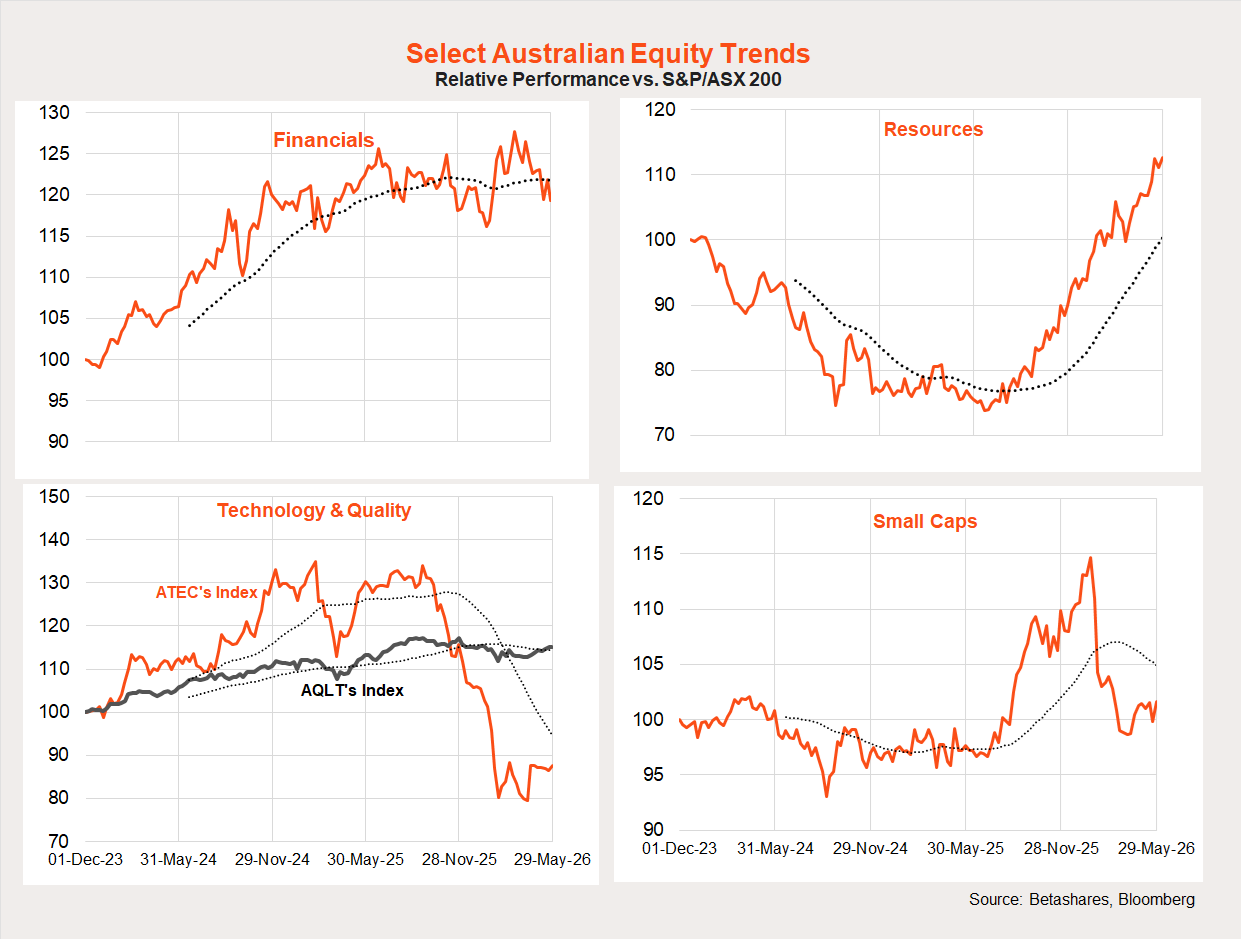
Energy was the losing sector last week while material and consumer discretionary stocks fared best.
Among major sectors, the trend remains of resources beating financials. After a significant sell-off over earlier months, the relative performance of high-beta technology and small cap stocks still appears to be bottoming out. The RBA/Budget double act is likely to see stocks exposed to the local economy struggle relative to globally exposed resource stocks.
Australia week ahead: Q1 GDP & RBA
The local highlight this week will be Wednesday’s Q1 GDP report, which is likely to show a slowing in Australia’s economic upturn over the past year.
Based on partial information to date, overall GDP growth is expected to be 0.5%, down from 0.8% in Q4. Excluding the artificial boost to consumer spending from the unwinding of electricity price rebates, household spending should be constrained. Capacity constraints and cost pressure also appear to be throttling back the upturn in dwelling construction – and to a degree public infrastructure investment. But the big story this week is likely to be strength in private investment, fuelled by the data centre boom.
RBA Governor Bullock and Deputy Governor Hauser are set to provide more commentary on the economy and interest rates on Thursday and Friday respectively.
Have a great week!
2 comments on this
I thought your analysis of the asymmetry between indexed capital gains and non-indexed capital losses was excellent.
It seems the pendulum has truly swung from an overly generous CGT regime to a punitive one, to the point where it’s now a regressive tax for those on low incomes. So those who are purported to benefit from more affordable housing now face a minimum 30% tax on the investments they’re making with the goal of saving for a house deposit.
Absolutely spot on. I cannot, for the life of me, understand how Treasury either fails to recognise or simply chooses to ignore the CGT implications for individuals. For example, a New Zealand citizen can sell Australian equities and pay 0% CGT, provided they are not an Australian tax resident. That alone highlights how inconsistent and distorted the system is.
These tax changes feel like a reactive response to decades of a system where tax minimisation has effectively been the primary objective. In many cases, if you’re not doing everything possible to reduce your taxable income, you’re putting yourself at a disadvantage.
It’s also the same system that has gone to great lengths to prop up an unsustainable housing bubble, driven by disproportionate tax incentives and heavy government intervention whether through LMI support, guarantees, or other policy settings. By continuously delaying what should have been a necessary market correction, these interventions have arguably caused significant long-term damage to the broader economy.
Instead of undertaking a thoughtful, strategic review of the tax system and addressing its structural flaws, the burden now seems to be falling on those investing in productive assets. They’re effectively drawing the short straw once again.
It’s genuinely frustrating and, frankly, quite irrational policymaking.