


One of the notable developments in global financial markets this year has been the rise in long-term bond yields.
US 10-year government bond yields have lifted from 4% at end-February this year to 5.3% by end-September – before easing to 5% in the past week. Australian 10-year bond yields lifted from 4.64% to 5.38% from end-February to end-September, though were back to 5.21% over the previous week.
This note examines the drivers of the rise and the outlook.
It’s largely due to monetary policy
A major factor behind the rise in bond yields has been the shift in monetary policy expectations. With the increase in short-term global inflation pressures due to both the Iran war and the artificial intelligence (AI) investment boom, most central banks have shifted from an easing bias last year to a tightening bias.
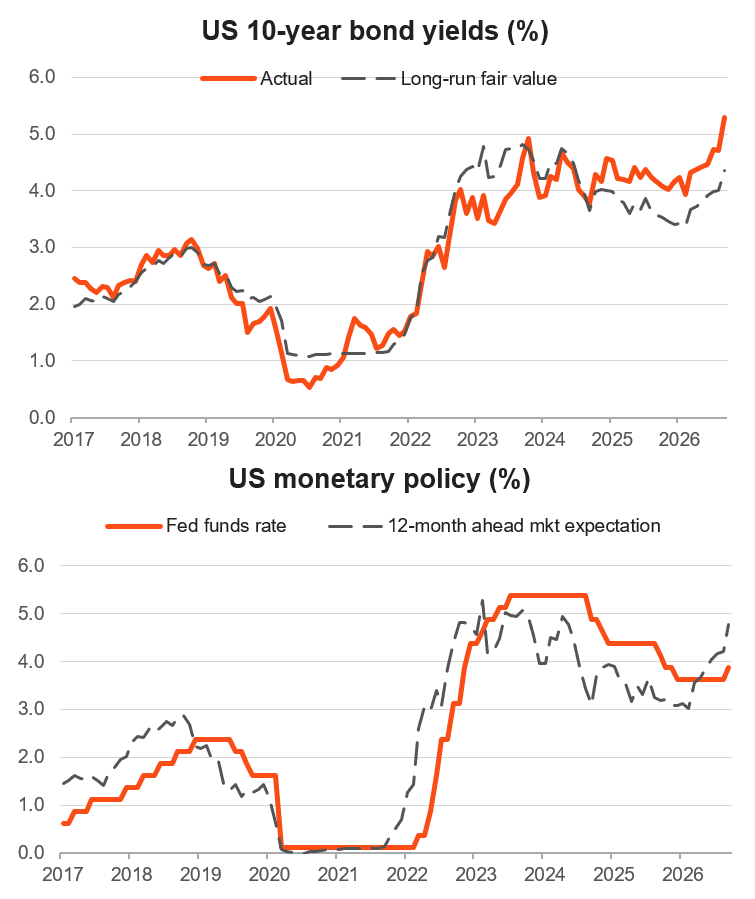
As seen in the chart below, the US market has shifted from expecting more rate cuts late last year to pricing in several Federal Reserve rate hikes. The Fed raised rates in September and most Fed officials continue to express frustration at the sticky level of inflation.
At end-February, the market expected the Fed funds rate to be 3% in 12 months’ time; by end-September, this had risen to 4.78%.
Econometric modelling1 suggests 10-year bond yields should have increased by around 1% in the seven months to end-September, accounting for 75% of the 1.3% rise in 10-year bond yields over this period.
Source: Bloomberg
However even in February, US 10-year bond yields were trading around 0.6% above what monetary policy expectations implied, and the rise in yields since February has been around 0.3% more than this model would have suggested.
This suggests other non-monetary factors could be at play – both historically and this past year.
It’s not inflation concerns
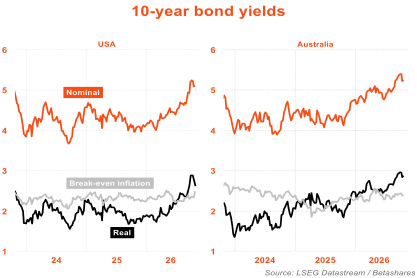
Contrary perhaps to popular media perception, this rise in yields has not reflected a rise in financial markets’ long-run inflation expectations.
As evident in the charts below, virtually all of the rise in nominal 10-year bond yields so far – in the US and Australia – has reflected higher real yields, as offered on inflation-indexed bonds. The difference between nominal and real yields, a broad estimate of the market’s implied long-term inflation expectation, has remained broadly unchanged.
Source: LSEG Datastream/Betashares
This is good news. Despite higher oil prices this year, sticky above-target inflation in both the US and Australia and simmering concerns about central bank political independence (especially in the US), financial market long-term inflation expectations have barely budged. Indeed, markets still ultimately expect central banks to get inflation back to target.
It’s not really newfound fiscal concerns, at least not recently
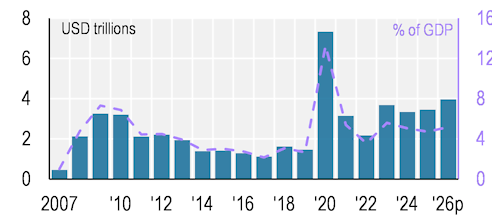
Another widely discussed rationale – rising public debt concerns – also doesn’t appear to hold much water. It’s true that Federal Government budget deficits in both the US and Australia remain uncomfortably high, but this has been a concern of markets for some time, with little notable change in recent months. As a share of GDP, advanced economy net borrowing has remained broadly steady in recent years, though up from the levels that prevailed in the decade before COVID.
That said, there was a modest step up in net borrowing since 2023 after two years of post-COVID fiscal consolidation.
OECD net government borrowing requirement
Source: OECD, March 2026
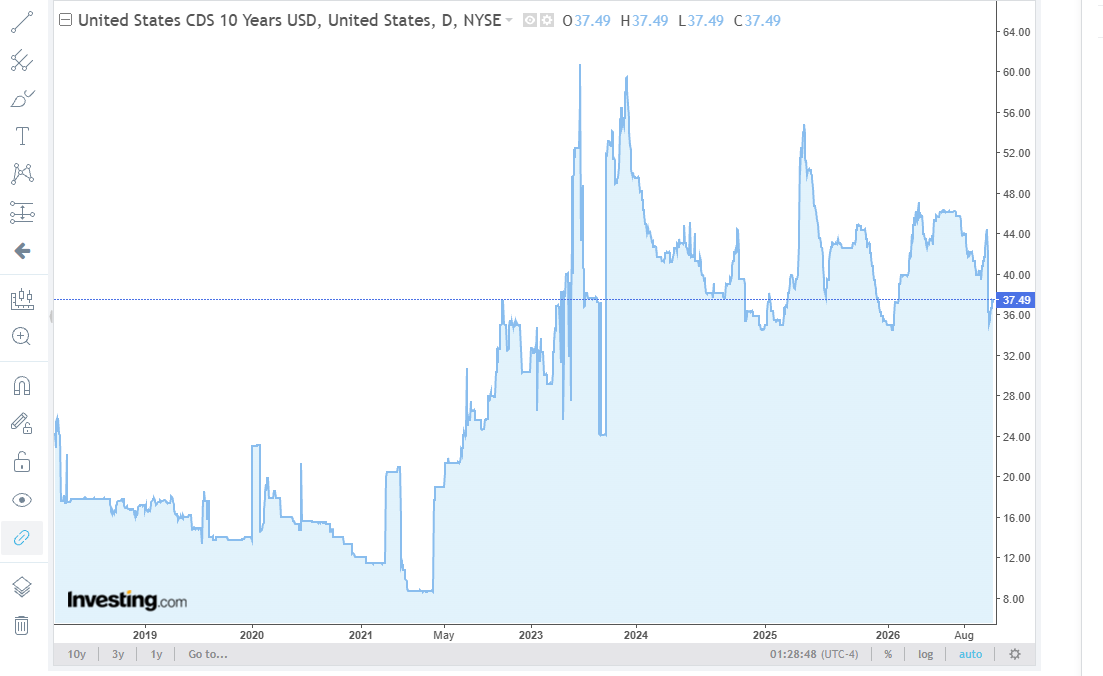
US sovereign credit default swaps (CDS) – a measure of the riskiness of US sovereign debt – have remained range bound so far this year. Note the CDS did blow out in 2023 when debt ceiling concerns raised a short-term risk that the US might not have sufficient funds to meet interest payments, potentially triggering a CDS “default”. US CDS rates have remained structurally higher ever since.
Source: Bloomberg (as at October 23, 2026)
Of course, rising fiscal concerns are evident in some countries of late, notably France, where deficit concerns have pushed bond yields above those of Germany.
Nor have other risk premia drivers increased recently
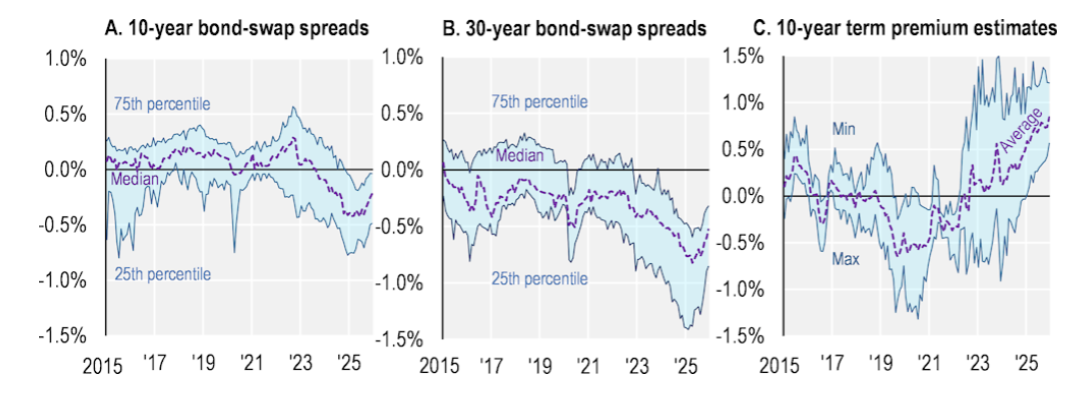
Structural shifts in other measures of long-term bond risk premiums are also evident since around 2023. Longer-term swap spreads2 have turned negative in recent years, indicating markets value government bonds less relative to gaining fixed-rate exposure via private-sector swaps. Estimates of term premiums (i.e. the yield on long-term bonds not explained by the expected path of short-term rates) have also increased.
Long-term bond valuation measures for OECD countries
Source: OECD Global Debt Report, March 2026.
Reasons for this structural shift include:
- Increased government deficits and bond supply in the post-COVID era (as noted above).
- Reduced central bank buying due to the switch from quantitative easing to tightening.
- Tighter capital requirements that make it more costly for some investors to hold bonds on their balance sheet.
- Reduced perceived diversification benefits of long-term bonds due to the sell-off in both bond and equity markets in 2022.
- A general increase in the level of interest rates that has reduced the “hunt for yield”.
That said, none of these structural forces are especially new this year – limiting their role in explaining the recent rise in yields.
What is relatively new? The AI debt boom
One obvious new factor is the growth in demand for long-term debt funding from AI companies.
As seen in the chart below, bond issuance by major US technology companies (the “hyperscalers”) increased notably in 2025 and has more than doubled so far this year. Other AI companies – such as neoclouds and chip makers – are also ramping up their debt issuance.
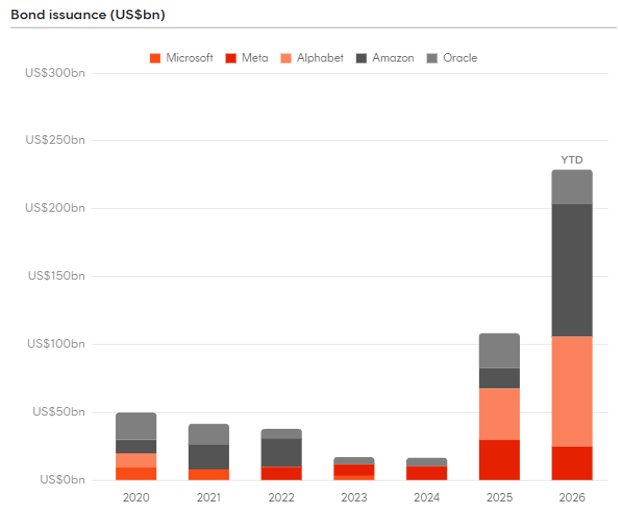
Source: Bloomberg, Betashares; Goldman Sachs Research, US equity outlook, 24 Sep 2026. Bond issuance as at 19 October 2026 (2026 year to date). Hyperscalers: Alphabet, Microsoft, Meta, Amazon, Oracle.
According to Morgan Stanley3, there’ll be around $US570 billion in AI-related debt issuance this year (from hyperscalers and other AI companies). That’s equal to 30% of the US Federal Budget deficit, and 15% of total advanced economy net debt issuance this year. With AI-related investment expected to remain high for the next few years, this will continue to place pressure on debt funding markets.
Rising bond yields reflect a combination of short- and long-term factors
All up, much of the rise in bond yields this year – in the US especially – reflects a shift in monetary policy expectations. To the extent that monetary policy will ultimately swing the other way, this will in time also help bring down bond yields.
That said, several structural shifts in recent years, namely increased government deficits and weaker investor demand for bonds, suggest bond yields will likely be higher going forward for given monetary policy settings.
On top of this, a new factor is rising AI-related debt financing, which is competing with governments for scarce long-term funding. This seems likely to maintain upward pressure on bond yields – all else constant – for at least the next few years as the AI investment boom rolls on.