

Luke Sheather
7 minutes reading time
Over the past few years, performance within the Australian sharemarket has been led predominantly by large cap companies. In fact, BHP and the Big Four banks alone have accounted for nearly half of the ASX 300’s total return over the past four years1, supported by earnings stability and pricing power during a higher-than-normal interest rate environment.
More recently, however, leadership dynamics appear to be shifting, with the mid and small cap segment moving into focus as years of lagging performance appear to be giving way to a recovery.
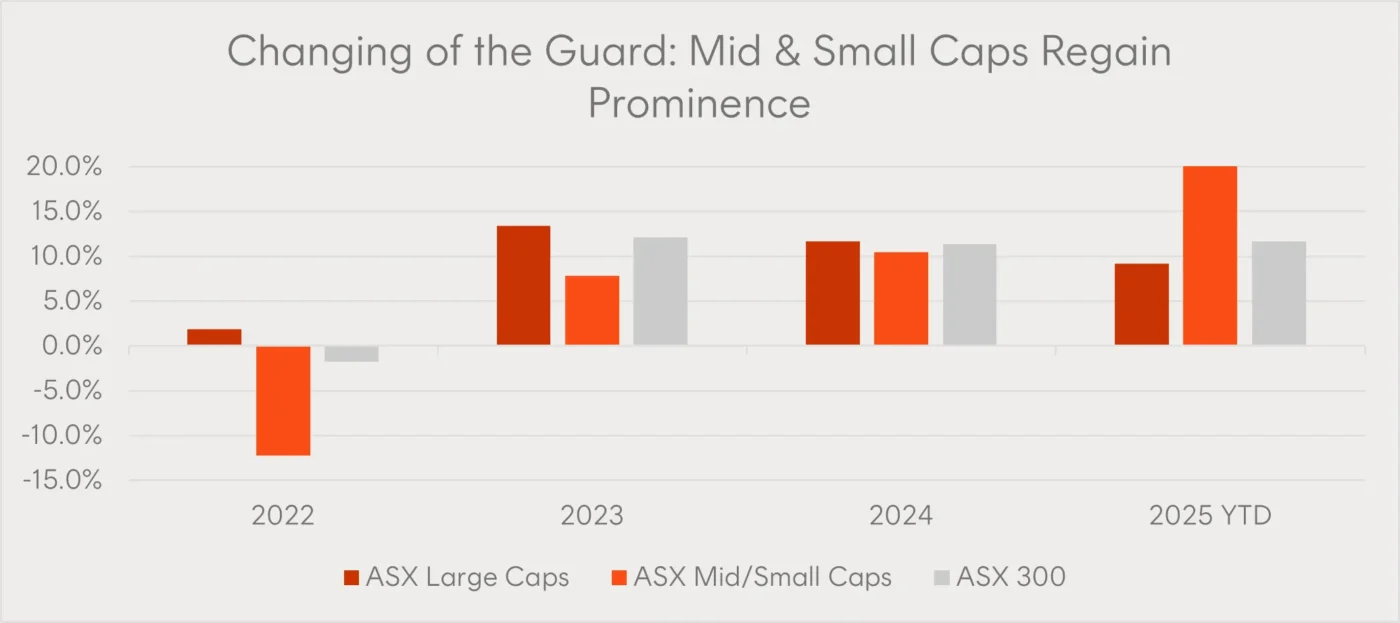
Source: Bloomberg. As at 30 September 2025. Returns each calendar year returns. ASX Large Caps refers to the S&P 50 TR Index. ASX Mid/Small Caps refers to the S&P/ASX Mid Small TR Index. ASX 300 refers to the S&P/ASX 300 TR Index. You cannot invest directly in an index. Past performance is not an indicator of future performance.
Policy tailwinds for mid & small caps
Australia’s monetary policy setting has been a key driver of this transition. The Reserve Bank’s shift toward a rate-cutting cycle has created conditions that are typically supportive for mid and small cap companies. Relative to large caps, these businesses are generally earlier in their lifecycle and are still expanding their product ranges and customer bases, leaving them more reliant on external capital to fund growth and more sensitive to borrowing costs. Consequently, easing cycles have historically favoured mid and small cap performance, relative to their large cap counterparts.
As the chart below shows, from 2015, the RBA’s downward rate trajectory coincided with sustained mid and small cap outperformance, which persisted through the COVID-19 stimulus period as policy rates bottomed. The subsequent inflation-led tightening phase pushed interest rates higher, which saw this relative outperformance drastically diminish. However, since early 2025, as the RBA pivoted back to an easing bias and expectations for rate cuts firmed, relative performance has begun to recover. Now, with additional rate cuts expected in the coming months, the backdrop looks even more encouraging.
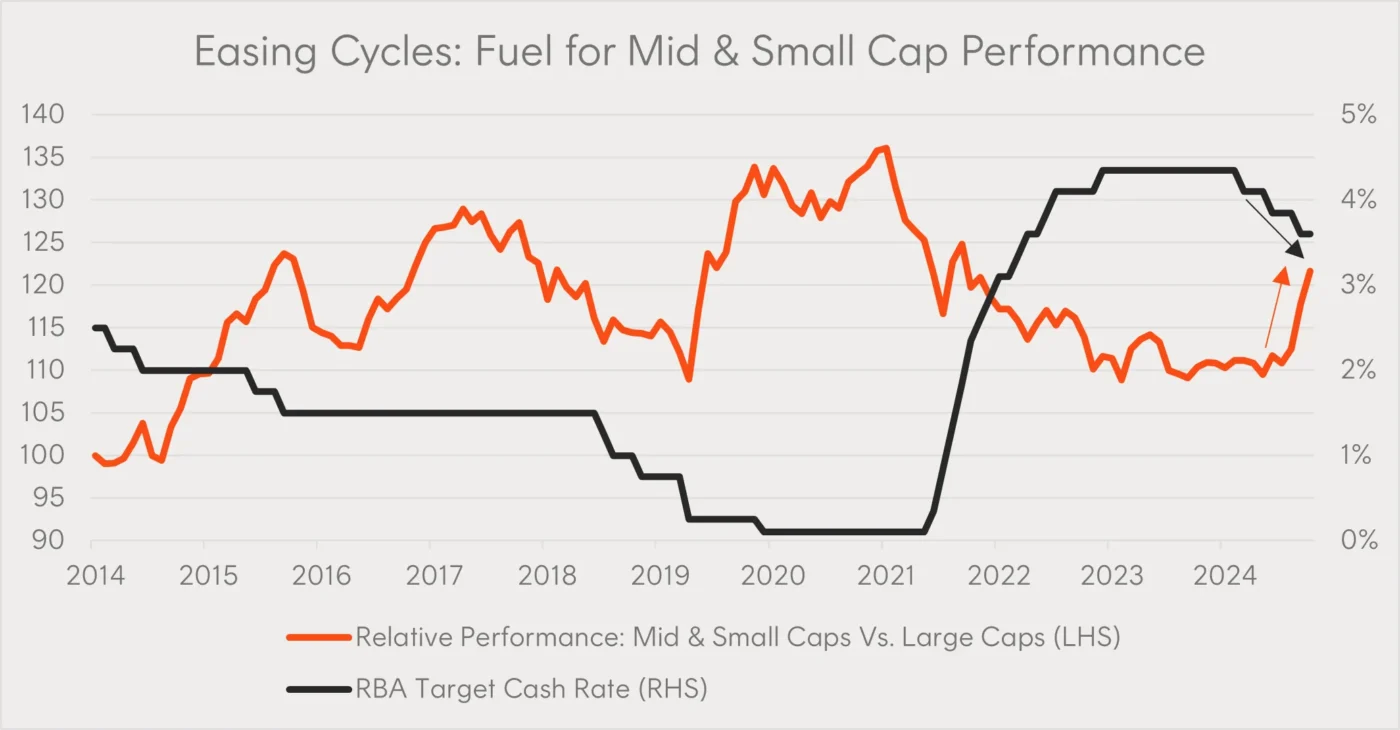
Source: Bloomberg. 31 December 2014 to 30 September 2025. ASX Mid/Small Caps refers to the S&P/ASX Mid Small TR Index. ASX Large Caps refers to the S&P 50 Index. You cannot invest directly in an index. Past performance is not an indicator of future performance.
Fundamentals further support a regime shift
Recent reporting seasons have shown mid and small cap companies delivering much stronger earnings growth than large caps, further driving the recent performance turnaround. Lower funding costs and easing input pressures are lifting margins and free cash flow across these segments.
The chart below indicates this trend is likely to persist, with 12-month forward earnings growth estimates for mid and small caps sitting significantly higher than large caps. Part of the gap reflects relative sector mix, with mid and small caps typically underweight Financials, where earnings growth is expected to be slower, and overweight higher-growth areas such as Industrials and Information Technology. This impressive growth profile, if sustained, can provide scope for further price appreciation in the periods ahead.
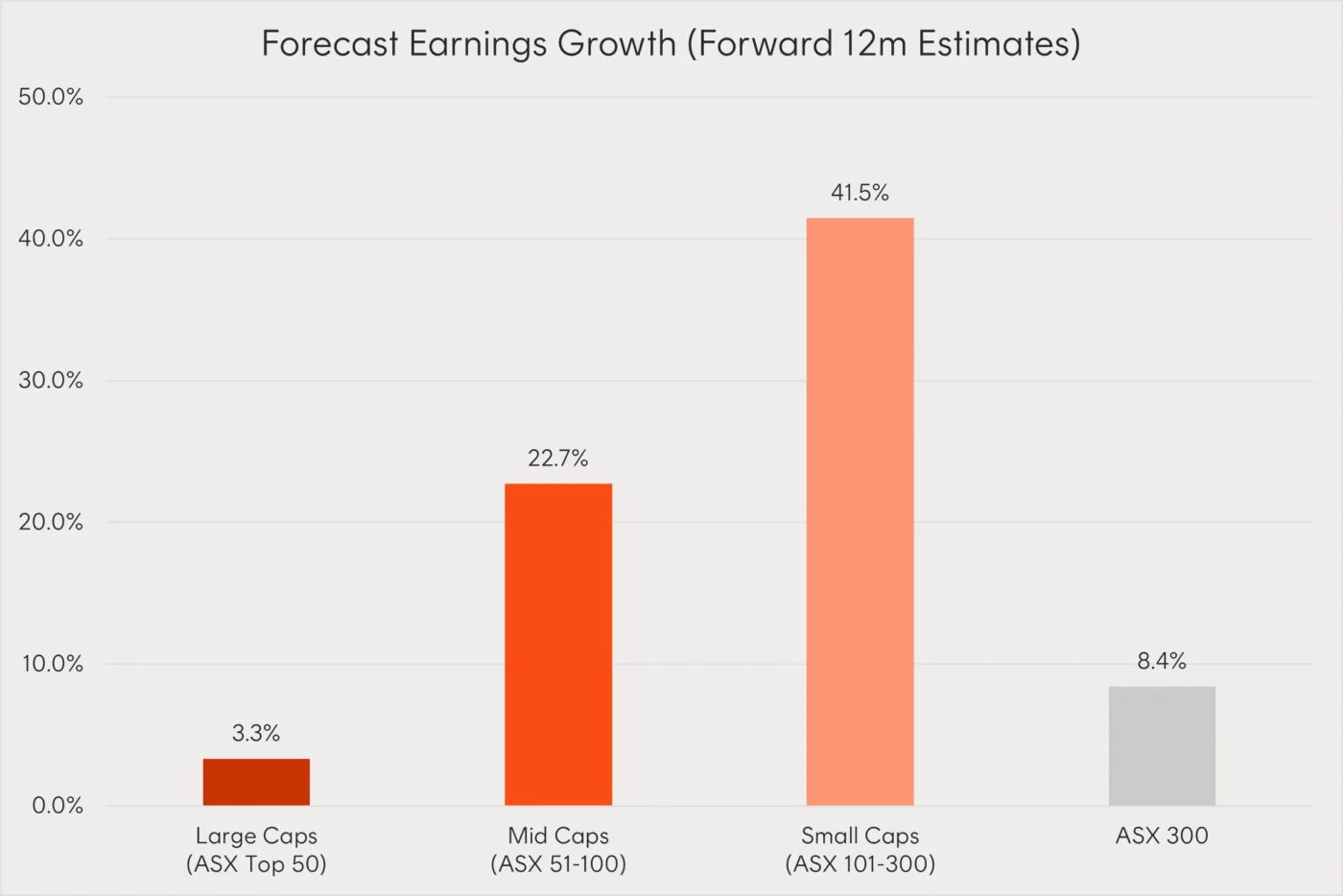
Source: Bloomberg. Earnings Growth reflects index weighted average of the forward 12 month estimates as at 17 September 2025. ASX Large Caps refers to the S&P 50 Index. ASX Mid/Small Caps refers to the S&P/ASX Mid Small TR Index. ASX 300 refers to the S&P/ASX 300 Index. Actual results may differ materially from estimates.
How to invest in these segments?
Mid Caps
Australian mid caps are often referred to as the sweet spot of the Australian sharemarket – being large enough to have bedded down established businesses, but still nimble enough to retain growth potential. The challenge for investors, however, lies in how best to access this exposure.
Relative to large caps, investing within this part of the market comes with greater dispersion between winners and losers. Consequently, stock picking in this segment has proven notoriously difficult. The latest Australian SPIVA Report, again, showed the majority of active managers fail to consistently beat a representative benchmark combining the mid and small cap market2.
Performance persistence has also been scrutinised, and among 160 active mid/small-cap funds that reported in 2022, just three managed to maintain their top-quartile ranking (based on 12-month return) the following year, with none managing it two years running3.
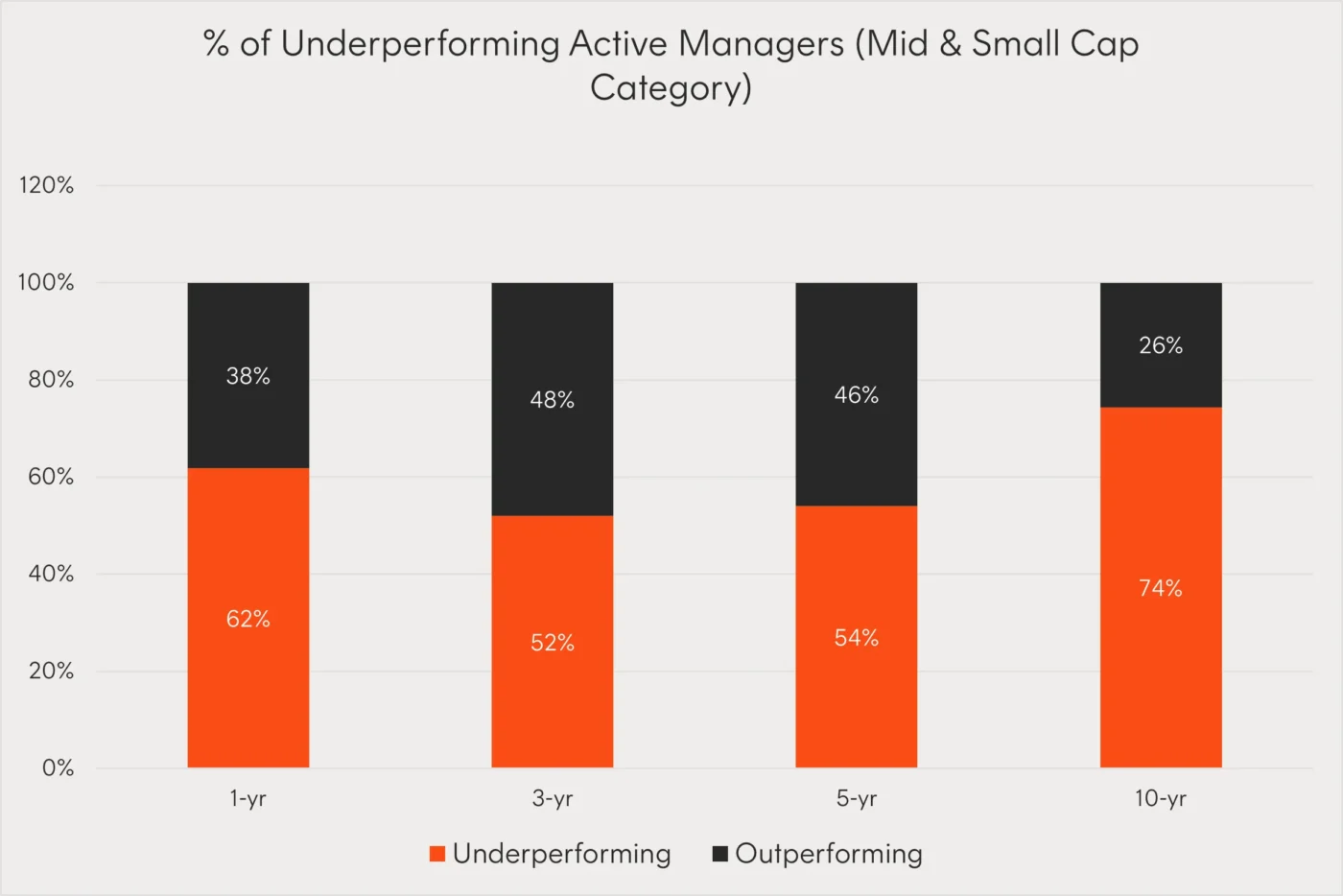
Source: SPIVA, S&P Global. As at 30 June 2025. S&P Mid-Year 2025 SPIVA Report. Performance is measured relative to the S&P/ASX Mid Small TR Index. The dataset includes all Australian Domiciled Mid Cap and Small Cap active managers.
For investors, this makes a passive approach particularly compelling.
Betashares Australian Ex-20 Portfolio Diversifier ETF (ASX: EX20) delivers market-cap-weighted exposure to companies ranked 21 – 200 on the ASX and provides a cost-effective way to harness the tailwinds, mentioned above, without relying on manager skill or short-term stock calls.
Compared with broad market indices, like the ASX 200, EX20’s sector mix is more balanced and less concentrated, reducing reliance on the big banks and miners, thereby enhancing diversification and providing a straightforward vehicle to access Australian mid caps.

Source: Bloomberg. Data as at 30/9/2025.
Small Caps
Small caps provide greater leverage to the rate-cutting cycle and offer attractive long-term growth potential but come with even higher variability in outcomes. In addition, the segment is typically crowded with speculative miners, unprofitable start-ups, and companies vulnerable to debt stress or insolvency. This creates a structural challenge for traditional small cap indices and passive approaches, as returns are often diluted by heavy weightings to fundamentally weak businesses.
Betashares Australian Small Companies Select ETF (ASX: SMLL) was specifically designed to overcome these structural issues. Tracking the Nasdaq Australia Small Cap Select Index, it applies rigorous, rules-based screens to exclude companies with negative earnings, poor debt-servicing ability, excessive valuations and the weakest price momentum.
What remains is a portfolio of 60-90 higher-quality and financially robust companies. SMLL therefore offers investors a refined small cap exposure that seeks to captures the upside potential of the segment, while mitigating downside risks to improve risk-adjusted returns through the cycle.
The bottom line
After a long period of large cap dominance, leadership in Australian equities appears to be shifting toward the smaller tiers of the market. The combination of a rate-cutting cycle and a stronger earnings outlook provides a supportive backdrop for mid and small caps alike. For investors, EX20 offers a diversified and cost-effective way to access Australia’s mid cap “sweet spot,” while SMLL provides a smarter, selective entry point into small caps. Both offer a compelling complement to diversify an investor’s core allocation to Australian equities, and a simple way to participate in the potential leadership shift.
Nasdaq and Nasdaq Australia Small Cap Select Index are registered trademarks of NASDAQ, Inc (which with its affiliates is referred to as the “Corporations”) and are licensed for use by Betashares. The Fund has not be passed on by the Corporations s to their legality or suitability. The Fund is not issued, endorsed, sold or promoted by the Corporations. The corporations make no warranties and bear no liability with respect to the fund. You cannot invest directly in an index.
There are risks associated with an investment in the Funds, including investment objective risk, small-mid cap securities risk, liquidity risk, market risk and small companies risk. Investment value can go up and down. An investment in the Fund should only be considered as a part of a broader portfolio, taking into account your particular circumstances, including your tolerance for risk. For more information on risks and other features of the Fund, please see the Product Disclosure Statement and Target Market Determination, both available on www.betashares.com.au.
Sources:
1. Bloomberg. Based on performance attribution of the S&P/ASX 300 Index, for the period 30 September 2021 to 30 September 2025. ↑
2. S&P Dow Jones Indices Mid-Year 2025 Australian SPIVA Report. As at 30 June 2025. ↑
3. S&P Dow Jones Indices Year-End 2024 SPIVA Australian Persistence Scorecard. As at 31 December 2024. ↑