

David Bassanese
5 minutes reading time


Global week in review: Renewed Iran tensions
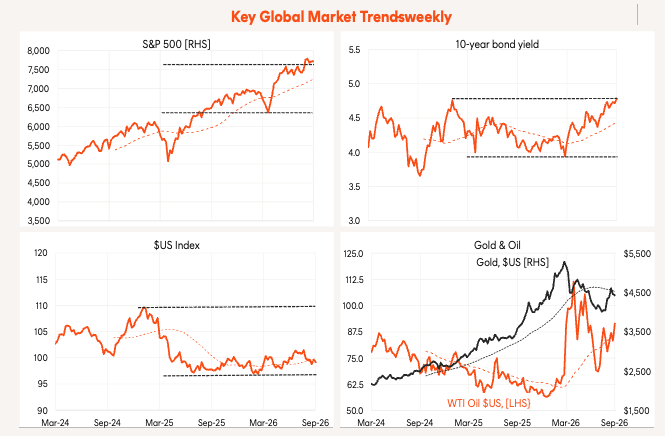
US equities were broadly flat last week with a resumption of the Iran conflict and lingering fears of a near-term US rate hike containing sentiment.

Source: Betashares, Bloomberg.
Renewed tit-for-tat attacks between the US and Iran confronted markets last week, resulting in a near 10% rebound in oil prices. There appears to be little sign of new talks on the horizon, with both sides seeking to test the resolve of the other. Long-term bond yields also edged ever higher.
The other major issue in markets is whether the Fed is on the cusp of raising rates next week. Fed Governor Waller made a dovish contribution last week, suggesting he’d be happy to keep rates on hold if inflation continued to ease (though he’d support hike rates if it did not!). But markets had little time to rejoice at this news, with a stronger than expected payrolls report on Friday. August payrolls lifted 162k, much stronger than the 50k expectation, with a 55k upward revision to employment over the previous two months. Fears of an undue slowing in the US labour market have been quashed again for now.
It means the decision on rates may critically depend on this week’s consumer price index report.
Of course, it hasn’t taken long for Trump to start pressuring the Fed into lowering rates, with nonsensical social posts last week – threatening to block trade with countries that run a trade surplus with the US – if the Fed did not act. Along with Treasury Secretary Bessent’s interventions in the bond markets, current White House economic policy hardly inspires confidence.
Global week ahead: US CPI
As noted above, this week’s US CPI result (due Friday US time) may well decide the outcome of next week’s Fed meeting. As it stands, the market expects another relatively benign 0.2% monthly gain in the core CPI, which would allow annual core inflation to ease to 2.4% from 2.5%.
To my mind, such a result would be good enough to keep the Fed sidelined next week. Despite this, the market is still attaching a 60% risk to a rate hike.
Outside of the US, the European Central Bank is widely expected to raise rates 0.25% to 2.5% when it meets on Thursday.
Global equity trends: Technology strongest performer
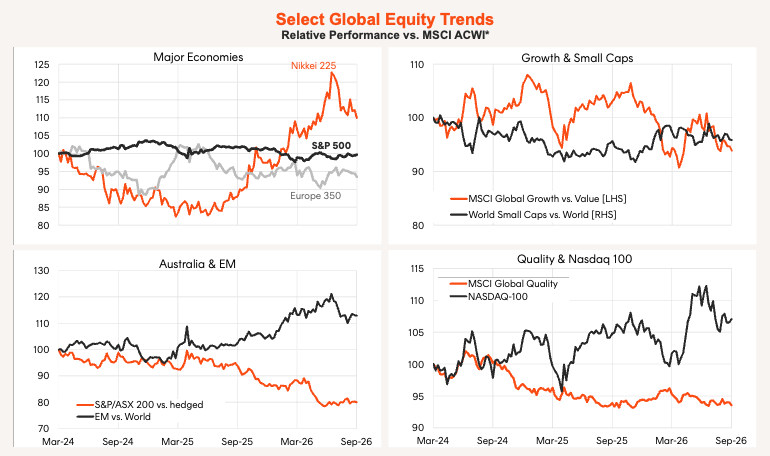
Energy underperformed last week despite the rebound in oil prices while technology fared a little better.
Sector trends remain choppy, with technology underperforming since mid-year and more value-orientated sectors such as financials and energy taking up the baton.
*All but value factors. Local currency basis. Source: Betashares, Bloomberg.
Australia week in review: Firm GDP
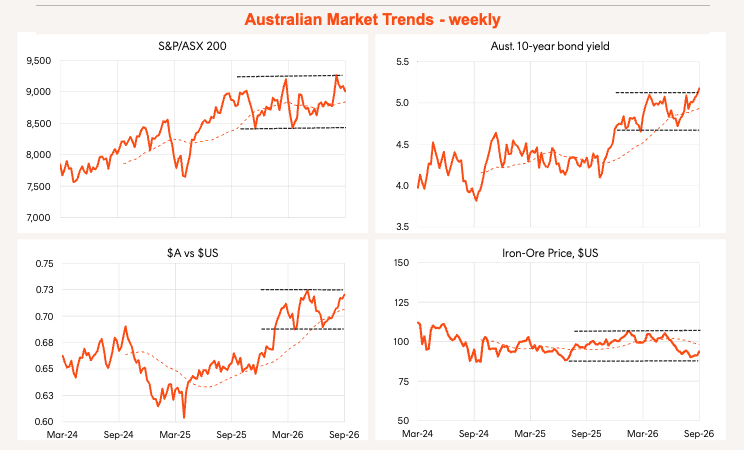
Local stocks weakened last week, with a firm Q2 GDP report heightening fears of a near-term rate hike.

Source: Betashares, Bloomberg.
At face value, last week’s Q2 GDP report was not especially strong. At 0.4%, the economy grew at a sub-trend pace in the quarter, with subdued domestic demand. Consumer spending grew a modest 0.4%, and business investment pulled back after the Q1 data centre related surge. Public demand was also relatively subdued.
That said, the overall GDP result was still a bit firmer than the 0.3% market expectation. And in its August Statement on Monetary Policy, the RBA also expected annual growth of only 1.9%, or less than the 2.1% outcome.
As a result, the moderately firm GDP result – along with last week’s hot July CPI report – has the market still nervous over a potential rate hike later this month. That’s despite continued declines in house prices, with Cotality reporting a further 0.9% decline in national property prices in August. It was the fifth consecutive monthly decline, leaving national prices 3.6% below their peak in March.
Local equity market trends: Rotation to resources
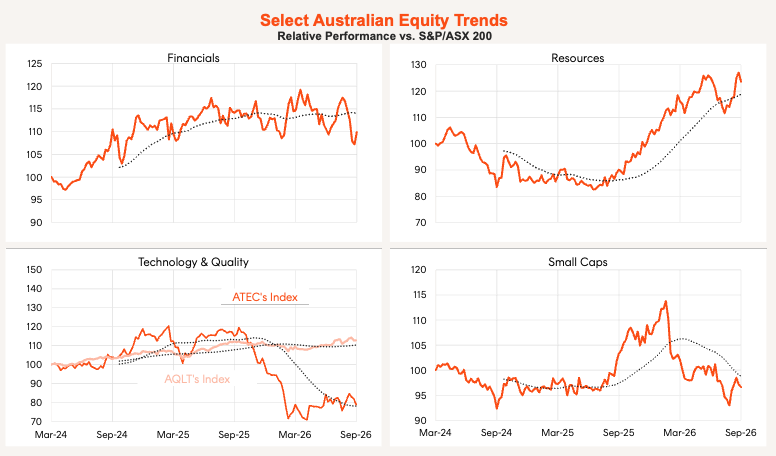
Materials pulled back last week, with some major mining companies going ex-dividend, while financials did better. Fear of higher global interest rates may have dented the commodity outlook, while improving that for bank interest margins.
The longer trend of late, however, has favoured resources over financials.
Source: Betashares, Bloomberg.
Australia week ahead: Business and consumer confidence
There is only second tier data this week, with the Westpac and NAB surveys of consumer and business confidence respectively. Consumer confidence is likely to remain in the doldrums, while the NAB measure of business conditions has also eased in recent months to below-average levels. A focus in the NAB survey will be the outlook for employment and cost pressure indicators.
Have a great week!