



This information is for the use of licensed financial advisers and other wholesale clients only.
The first half of the year has been challenging for Australian equities with three consecutive rate hikes, landmark tax reforms and a weak earnings backdrop presenting headwinds for our local market. While the ASX 200 Index was flat during this period, pleasingly the HYLD S&P Australian Shares High Yield ETF has delivered a strong mix of capital growth and income with total returns amounting to 8.0%1.
Longer term, the S&P/ASX 200 High Yield Select Index (the index that HYLD seeks to track) has delivered 12% p.a. and 11% p.a. over 5 and 10 years respectively as at 31 July 2026.
Under the hood – how has HYLD performed?
HYLD has recently reached its one-year anniversary and has outperformed the ASX 200 by an impressive 12.8%1 with the following chart illustrating the growing performance differential over time.
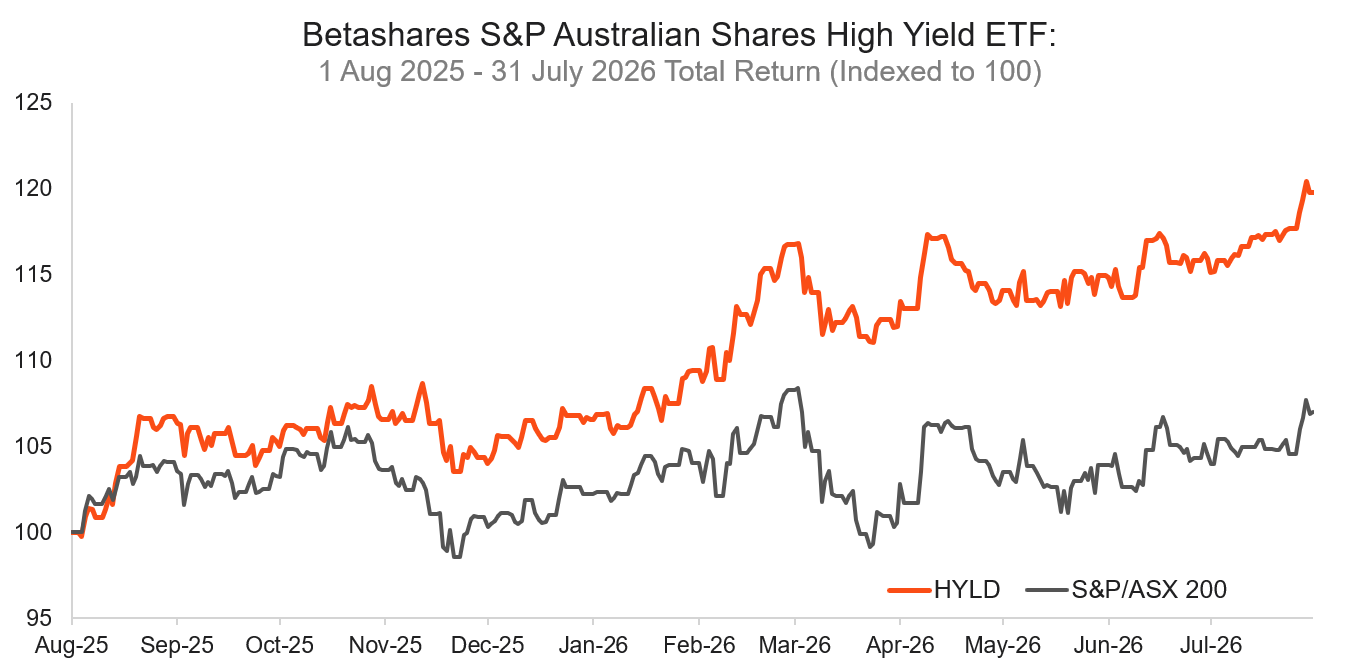
Source: Bloomberg. As at 31 July 2026. Past performance is not an indicator of future performance. You cannot invest directly in an index. Short-term performance can be volatile and is not a reliable guide to future returns.
While HYLD’s weights to ANZ, Rio Tinto, Westpac and BHP have contributed to this outperformance, holding no allocation to CBA, CSL, Xero and WiseTech (down ~70%) has also helped. In other words, holding more of the winners and less, or none, of the losers have collectively contributed to HYLD’s strong performance relative to the broad Australian share market.
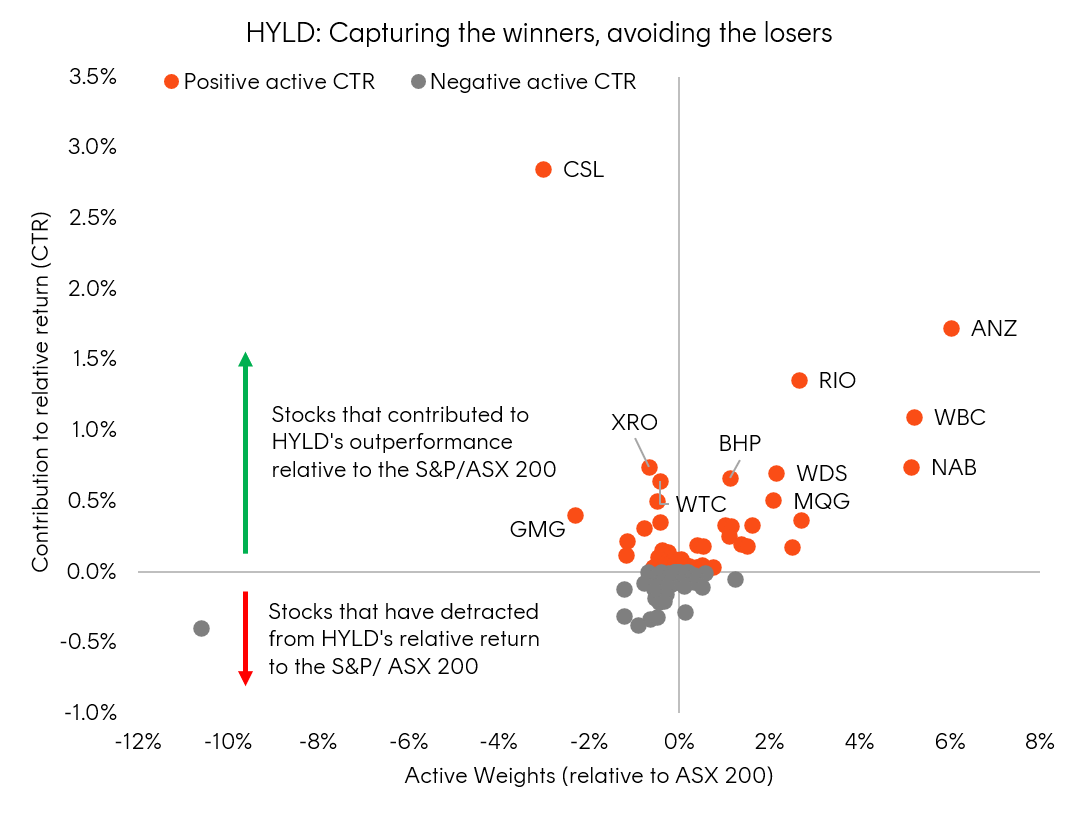
Source: Betashares. Based on attribution data of HYLD and S&P/ASX 200 from 1 August 2025 to 31 July 2026 and includes the stocks held within HYLD during this period. There is no guarantee these stocks will remain in the HYLD’s index or be profitable investments. Past performance is not an indicator of future performance.
What has been more impressive though is the resilience in HYLD’s performance since the onset of the Iran war on February 28, 2026. While the benchmark ASX 200 Index was down 3.4% from this date to end June 2026, HYLD’s performance was flat, demonstrating that during this period of heighted market volatility, the ‘High Yield’ factor has tended to perform well as investors favour more mature companies with established cash flows compared to growth-oriented companies. Over longer-term horizons, the ‘High Yield’ factor in Australia was the best performing over the last 5 and 7 years compared to a number of factor investing strategies.
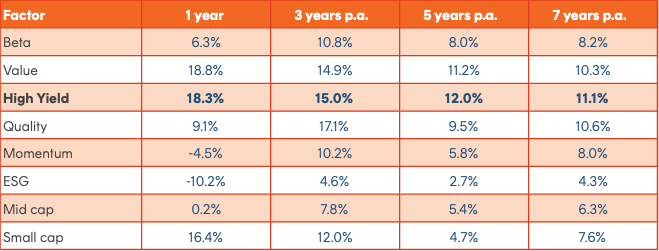
Source: Bloomberg. As at 30 June 2026. Returns greater than 1 year are annualised (p.a.). Performance is based on the underlying indices for the following Betashares ETFs: A200 (Beta), QOZ (Value), HYLD (High Yield), AQLT (Quality), MTUM (Momentum), FAIR (ESG), EX20 (Mid cap), SMLL (Small cap). You cannot invest directly in an index. Past performance is not indicative of future returns of the indices or the ETFs.
Attractive, monthly income
HYLD’s monthly distribution frequency is another important point of differentiation for investors. HYLD has now paid 12 monthly distributions, with an annualised cash dividend yield of 4.2%. This is materially higher than the expected 3.2% cash dividend yield of the ASX 200, and HYLD’s relatively smooth distribution profile makes cashflow management simpler for investors than the lumpy ASX dividend season payout timings.
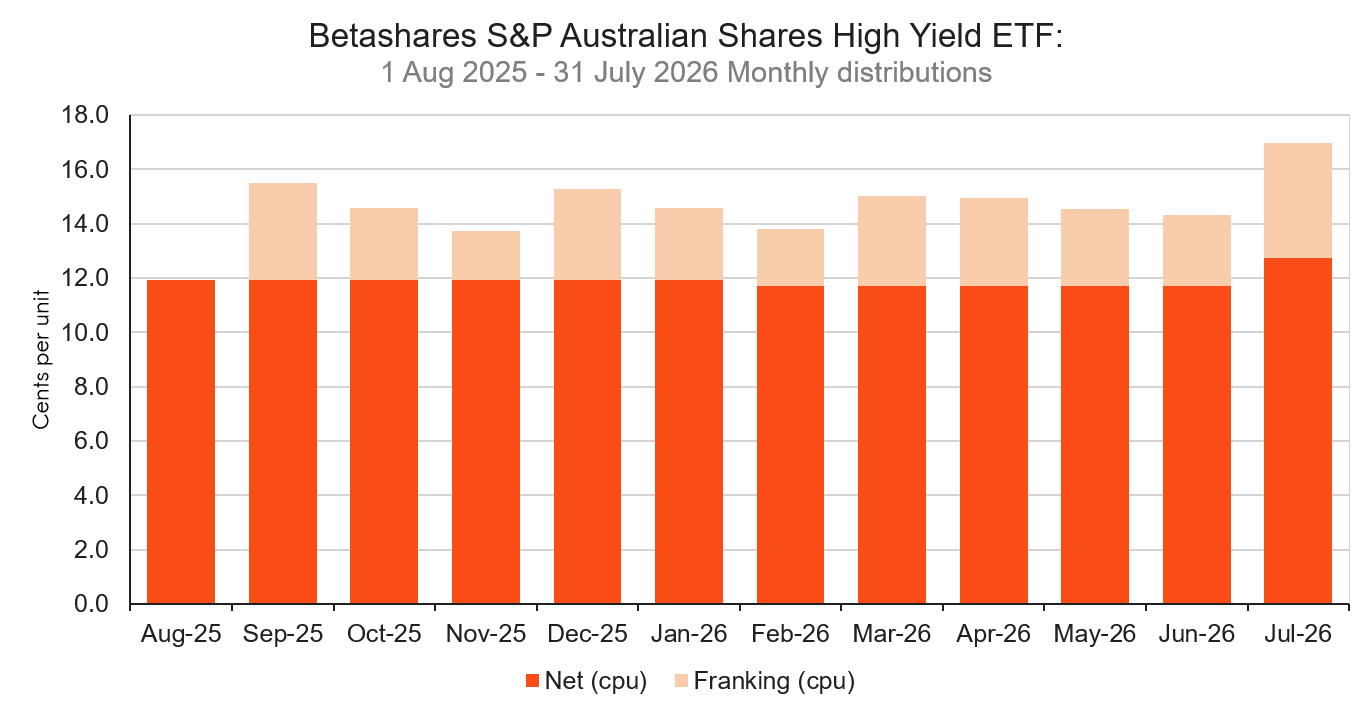
Source: Bloomberg. As at 31 July 2026. Past performance is not an indicator of future performance.
Why invest in HYLD
In an environment of ongoing geopolitical uncertainty and falling headline dividend yields, HYLD offers high yield Australian equities exposure which can be used as a core holding. The ETF is ‘Recommended’ by Lonsec and already holds over $100 million in assets under management.
HYLD provides Australian investors with:
- Low-cost, diversified, dividend income: HYLD aims to track the S&P/ASX 200 High Yield Select Index (Index), before fees and expenses, providing diversified exposure to a portfolio of 50 of high yielding stocks. HYLD can be used as an investor’s core Australian shares portfolio allocation. HYLD’s management fee is 0.25% p.a. 2
- Monthly income with franking3: HYLD pays distributions on a monthly basis, providing investors with a more frequent income stream than other high yield Australian share ETFs that pay quarterly distributions. A monthly cadence also means investors may be able to receive income more frequently than if invested in just individual shares.
- Intelligent approach to enhancing yield: HYLD seeks to improve on traditional strategies that utilise forecast dividends by also aiming to screen out potential ‘dividend traps.’